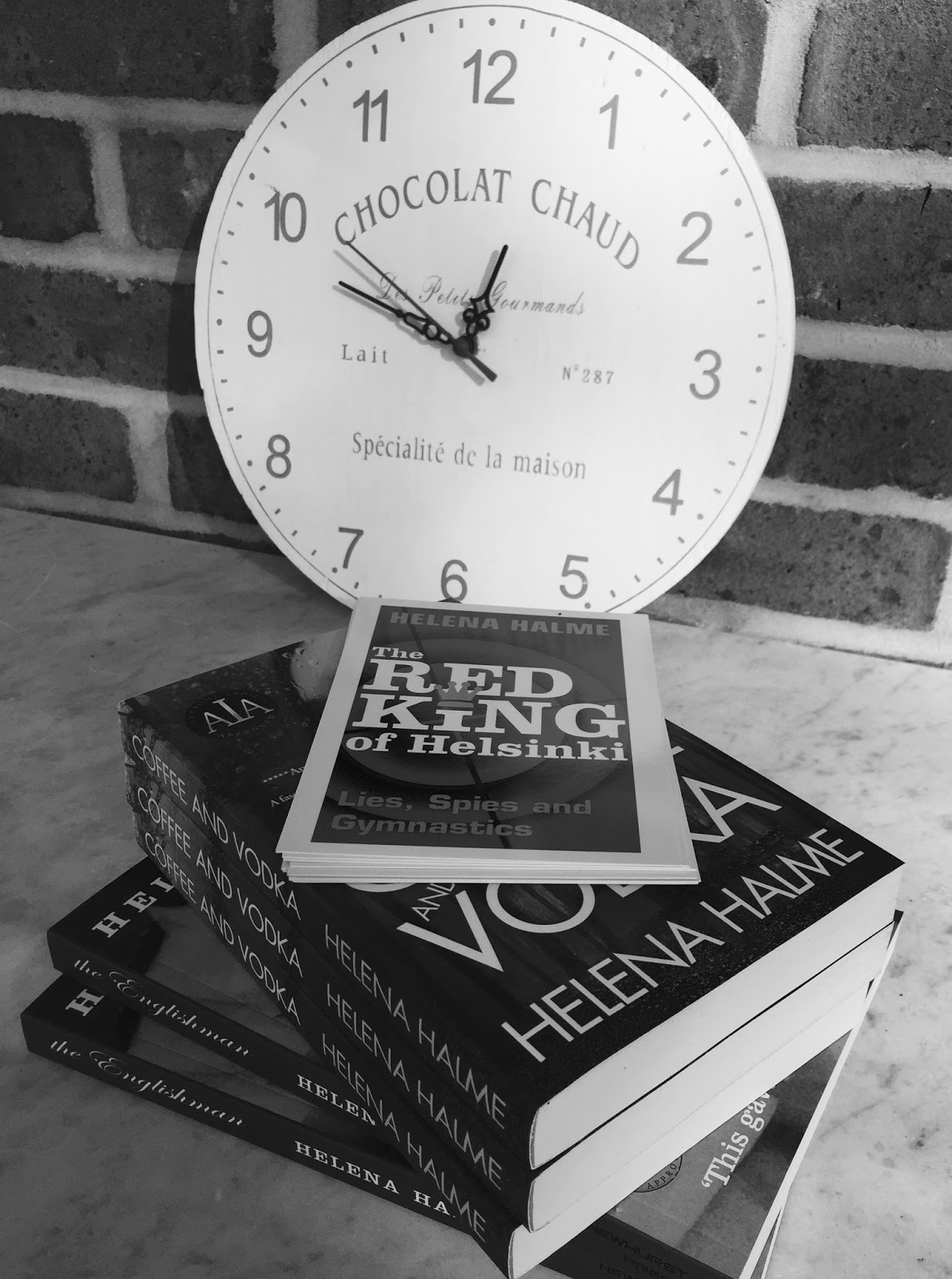
Showing posts with label The Englishman. Show all posts

Thursday, 17 December 2015

The Navy Wife is now out on Kindle

The Navy Wife, the long-awated sequel to the Nordic tale of long-distance love, The Englishman, is now out in Kindle form. I know it's been a long time coming, so I am absolutely delighted that I can finally say the novel is published.

To buy, click this link.


Marriage to The Englishman, Peter, was a mere dream for Kaisa when she was a student in Helsinki. It’s now 1984 and Kaisa wants a career as well as Peter. But no one wants to give a job to a young, foreign Navy Wife. Kaisa’s frustration creates bitter rows between the newlyweds, which she regrets each time her submariner husband goes away.

Enter rich, charming and clever Duncan, who seems to have all the answers to Kaisa’s problems. With Peter away on a long patrol, can the lonely and bored Kaisa resist Duncan’s advances?

The Navy Wife is available on Kindle here (US) and here (UK). It is also available on other international sites, please see your local Amazon store. Download it now! 

New Website


My new website is also now up and running, so please go and visit www.helenahalme.com. I will be blogging there as usual, but please remember, if you are following me on Blogger, you will no longer get notifications that way, so please sign up for my newsletter here or on the new site above.

As always, don’t be shy – share the news of my latest book release on Twitter, Facebook or by email (or shout it from the rooftops!).

Thank you!

Tuesday, 8 December 2015

Advice for New Writers Part 4: How to Increase the Speed of Writing

In Part 2 of this series of posts, I talked about editing your work, and how the first draft is always just that, a draft – an incomplete piece of writing. Having said that, without getting those words out, without that first draft, you cannot move forward and produce a finished product - your novel.


Of course, the faster you can write the first manuscript, the better.


Now that I have taken the bold step of giving up my day job to be a full-time author entrepreneur, I am hoping to write at least two novels per year, as well as some non-fiction books, so I've been looking into how I could speed up the process of writing.

Having time to write is crucial, but it's also important that you make the time to write


As you know if you follow this blog, I took part in the National Writing Month, or NaNoWriMo, to motivate me to write about 2,000 words every day. It worked, and I now have a first draft of a novel. I am also now so used to the daily writing routine that I feel strange if I haven't put down at least a few words, even if I cannot manage the 2,000 every day.

During this process, I found that one way to speed up your writing, is to have to have an idea of the plot, characters and setting for the novel. I'll go into more detail on the various main elements of the first draft of a manuscript below.

Plot


Since you are already thinking about becoming a writer, and want to write a full-length novel, you must have an idea of what you want to write about, even if it isn't a fully fledged plot. Two of my published novels took shape after I got obsessed with a story from my past, or a piece of news I saw. My virtual desk is full of half-finished novels, which came about in a similar way; and I intend to revisit each one. Nowadays, however, I try to plot ahead a lot more, simply because it makes the writing process so much easier, but this is something that is different for ever author I know. We all have our unique ways of working. An ideas board is a great way to start – just jot down what happens in the book and develop them into a plot. You'd be amazed how easy this is. Or think of the story in a summary: "Jane is in love with a guy who won't even look at her. One day, she sees him sitting in a cafe alone, and Jane bucks up the courage to talk to him. It turns out they have something crucial in common..."

Characters


The characters often come first, before the plot, but there are no hard and fast rules. With most of my published novels, the characters emerged as I wrote, which meant a lot of editing afterwards to make sure the descriptions matched throughout the novel. Sometimes, however, the characters are so clear from the beginning, that all you need is to keep a record of the gender, age, look, inner conflicts, role in the story and particular mannerisms and so on. Of course it depends on whether you are describing the main protagonist, or one of the main characters in the novel to which degree of detail you go into. Having said that, I tend to know up to the level of what shoe size any of my characters wear, or what their favourite lunch-time spot is. In the third book in The Englishman series, I got to know a very minor character, one of Kaisa's bosses in the England so well, that I described his hairy calves in one scene. And no, he's not a love interest. (Or is he? You'll have to wait to read the book to find out!)

Setting


Most of my novels are set partly in Finland, my country of birth, and a place I seem to be obsessed with. It's good to write about a place that you have experienced yourself, or you have a vivid idea of. Of course the setting doesn't have to be real, and you can change things around in a place to suit the story, as long as you make sure the changes are consequential. With Google Earth and Street View it's easy to find out what places look like, but remember this means it's also easy for your readers to see if you've made a mistake. Most readers want a book to take them somewhere new, or different. If I had a penny for every time I hear that my readers loved learning about Finland through my books...


No plot, no characters, no setting?


Don't worry if you are writing your first novel, and haven't sorted out a definite plot, all of the characters or settings. Once you start writing a story, these tend to sort themselves out anyway. The most important thing you can do is to write every day - even if you don't get to more than a few hundred words per day.  Just get into the habit of writing  - whatever happens and wherever you are. At home with a cold, on the train to work, in a cafe, on holiday - I even took my laptop with me when my husband was in hospital (it was a routine op, but still). And don't give up. I wish someone had told me not to give up when I first started writing seriously. I would now have a lot more novels under my belt, and a few less half-finished manuscripts in my drawer...

A few tricks


If I'm struggling with a manuscript, I have learned a few tricks to get me going with the writing again.

  1. Walk away. Sometimes it's good to take a break. Have a coffee, go for a walk, or if nothing else works, take the writing elsewhere – another room, a coffee house or the library.
  2. Go onto a new scene. Leave the bit you're stuck on and start writing another scene. Remember this is the first draft, so it doesn't matter if scenes are incomplete. You can come back and write more on the section you gave up on, but often if a scene is difficult to write, it may not belong in the novel. In any case, you can fix all that in the 2nd draft.
  3. Google it. I've talked about research before, and I use it a lot to get over a mini writer's block. The more you learn about the subject, the more inspired you'll feel to carry on. Sometimes, if you can, it's good to physically go to the setting to be inspired. I dragged the Englishman up to Scotland on holiday last year, so I could see the place where my characters lived. While I wrote The Navy Wife, I often went back to look at the photos I took during our trip.
  4. Start re-planning the plot on whiteboard, or on your computer. Just jot down ideas – anything – and you'll soon find a scene you can write. Or go back to your original ideas. Don't worry if it's the ending and you're written only 10,000 words so far. Those other words will come, I promise.
  5. Re-read what you've written already. This is a bit of a last resort for me, because it means I will start re-editing and at this stage I don't want to fall into that (time-consuming) pit. But needs must, and if there is part of the manuscript I particularly like, I return to that and hope that my inspiration returns.


Finally, a word on writing software...


The software you use for writing can speed up the process as much as the planning ahead can. I have recently started using Scrivener, as opposed to Word, and I have to say it has been a revelation. This software allows me to write a lot quicker. I can review my work more efficiently, and there are areas for research, characters and settings, which you can fill in when you think of them and then refer to easily. Previously, I had all of this on pieces of paper, or saved somewhere in a folder on my laptop, or just bookmarked on my browser. I could never find anything!


But remember, whatever software you use, the words you produce for your first draft aren't going to be those that will be in the final print (or ebook) copy. Let you inner critic have a holiday and just write, write and write. That critic can have his or her field day as soon as the editing process begins.


I hope you've enjoyed this series of Advice for New Writers so far. The next instalment, '5 Ways to Learn Your Craft' will be out in the New Year.


Until then, happy writing and please subscribe to my newsletter here for all book offers, news and more!


Friday, 27 November 2015

New cover for The Englishman!

I thought since it's Friday you'd like to see the new cover that The Englishman will be wearing to celebrate the publication of THE NAVY WIFE, which will be very soon.

So (drumroll, please...) here is the new cover for THE ENGLISHMAN, what do you think?


Don't forget THE ENGLISHMAN wearing his old uniform

is NOW ONLY £0.99 !

But hurry, offer ends on Sunday 29th November.

Monday, 23 November 2015

Black Friday week is here - The Englishman is only $0.99 ! *


To celebrate this special week and the forthcoming sequel, The Navy Wife, The Englishman Kindle copy is only $0.99! *


But hurry, the offer ends Sunday 29th November!


                          ‘A stylish Nordic tale of long-distance love'

“The Englishman is quite the page-turner, I had difficulty stopping myself from devouring it in one go. All the small details about Finland and Sweden give the book such colour, and I love seeing England through Kaisa's eyes! Highly recommended!” – Tania Hershman, author of 'My Mother Was an Upright Piano'.    

The Englishman 


Plus, I still have a few copies of the paperback bundle, including Coffee and Vodka and The Englishman for only £10!


Remember, you can have the books signed and posted to you for FREE ! **

Please email me on HHalme@icloud.com with details of what book you'd like and if you'd like them signed, and I will send you a bill via Paypal and ask my elves to post the book to you.


But hurry, this is a strictly limited offer until stocks last!


But, as always, don’t keep this offer under you hat, sharing is caring. Let your friends and cats and dogs know about my offers! 

Thank you, Helena xx

*  Excludes tax
** FREE postage to UK only.  If you are in the US, Europe or elsewhere in the world, please contact me on HHalme@icloud.com. Thank you.

Thursday, 19 November 2015

Limited Special Offer - signed paperback books for Christmas!


I have an exciting limited offer on The Englishman and Coffee and Vodka!

Normally  the paperback copies of each book are £7.99, but now I can offer them to you for a very special price.


Both titles for £10, or each for £6!


Plus, you can have the books signed and posted to you for FREE ! *


Please email me on HHalme@icloud.com with details of what book you'd like and if you'd like them signed, and I will send you a bill via Paypal and ask my elves to post the book to you. Or you can simply leave a message below.


But hurry, this is a strictly limited offer until stocks last!

And, as always, don’t keep this offer under you hat, sharing is caring. Let your friends and cats and dogs know about my offers!


* FREE postage to UK only.  If you are in the US, Europe or elsewhere in the world, please contact me on HHalme@icloud.com Thank you.

Tuesday, 17 November 2015

Approaching the pinnacle - a NaNoWriMo update


For me, this, the third week of the National Writing Month, has been the most difficult to date.

On Friday after I'd reached 25,000 words and got myself another badge (hurrah), I decided it was time to have a bit of a celebration. After a very late night with friends, Saturday's word count was the lowest to date, just below the 1,000 mark. No more celebrations and late nights I decided, and on Sunday I managed my usual 2,000 words.

On Monday I just couldn't get up at my customary NaNoWriMo time of 6am, and when I sat at my desk at 7am, words just were not presenting themselves to me.

Whenever this kind of freeze (or writer's block for want of another term) happens, I do what my MA in Creative Writing tutor told me, 'Research, research and research.' In those days, more than ten years ago, research meant getting out of the house and into a library or newsagents, or out onto the streets. Though I sort of miss those days, being able to go places without leaving your desk is so much quicker and easier.

After an hour or so on Google Streetview and reading hairy newspaper reports on Royal Navy courts martial, I managed to write 2,000 words as usual. But it wasn't easy and took me the whole of the morning. The poor terrier had to wait until 11 am for his walk, whereas almost every day during the first two weeks of NaNoWriMo, I've been done by 9 o'clock.

Again today, Tuesday, day 17 of NaNoWriMo, the words just didn't flow. After an hour I'd produced only 600 words, so I decided to turn things around. Instead of waiting until the words were done for the day, I had breakfast and took the pooch out for his walk, and decided to return to my writing later. When I sat down at my desk again, with a second coffee of the day, I managed to get up to just over 2,000 words.

Walking the dog, it occurred to me that I'm approaching what I know will be the centre of the novel. The action needs to reach a pinnacle - a sort of eruption where the main characters come together in a either disastrous or a happy plot twist. I know what this twist in A Navy Wife is in broad terms, but I really, really want to make it good, and this must be what's blocking me.

Of course when I think about it, none of this is new. I must have at least five novels in my virtual desk drawer that I've lost interest in around the 30,000 word mark. There is something scary about getting past that word count. It's as if this is where the novel becomes a reality, and you have to know what you are going to do with the plot and the characters. You also know if the novel is going to be good or not at this stage - or you think you do. It's that old friend, Internal Critic, who starts to play a part, and before you know it, you've convinced yourself that the work you've done thus far is rubbish.

But the strange thing is that unlike my previous novels, I know almost exactly what is going to happen in A Marriage Adrift. I even know what's going to happen in the next novel in The Englishman -series. Having read back a few chapters I also think (in my humblest of opinions) that A Marriage Adrift is going to be alright - possibly my best writing yet. So what is my problem? I wish I knew....

Writing can be so frustrating sometimes - or all the time!

Anyone else have similar experiences?

Sunday, 8 November 2015

The Navy Wife cover reveal!

The Navy Wife, a sequel to my Nordic romance, The Englishman, will be out at the end of this month, and I can now show you the fabulous cover which my new designer, the uber talented Emmi, has created.

I hope you like it, I am totally in love with it, but then I am a little biased...


What do you think?

To co-incide with the publication of The Navy Wife, there will be a special offer on The Englishman, so if you'd like to be first to hear about it, sign up to my newsletter here.

Saturday, 31 October 2015

Advice for New Writers Part 3: How Long Does it Take to Write and Publish a Novel?

This is number three in a series of posts about writing and publishing fiction. You can find the previous posts here.


How long does it take to get your novel into print (or out in ebook form)?


Writing a novel takes time. How long a first draft takes to produce is highly personal, but at the end of the day, it's all about maths. In the summary below, I've used the minimum time each stage will take, so please use it as a (very) rough guide only:

If, say, you write 1,000 words each and every day (including weekends, Christmas Day and so on), it'll take you 70-100 days, or 2 -3 months to complete the first draft of you manuscript. If you write, say 5 out of 7 days per week, this will become 3-5 months and so on.

  • Writing 1st draft: 3 months


Add to that the editing process. Your own edits can take two or three weeks.  If you use a professional editor, who has to fit your novel into their schedule, this will take a couple of weeks. Then there are the rewrites, if these are required, and the final proof read. Tip: If you are confident about when your final manuscript will be ready, do book an editor (and proof reader, interior layout and cover designer - see below) well in advance. This will save you valuable time in the publishing process.

  •  Editing: 1 month 

If you send the novel out to be read by a number of readers, something which I highly recommend for the first novel at least, this will also take time. Beta readers are valuable source of reviews, which will gain your book highly important visibility online. But you cannot expect anyone to take less than a month to read your masterwork.

  • Beta readers: 1 month


Finally there's the interior layout and cover design (if you're outsourcing this part), which, if you've managed to book these in advance, could do the job within a couple of weeks. There are pieces of software which can do the inside design for you, like Scrivener, and you can also design the cover yourself. (I am a great advocate for a professionally designed cover, but that's another discussion.) If you want to publish your book in paperback as well as in ebook form, getting a proof copy and stock sent to you will set you back another two weeks (minimum).


  • Cover, layout and interior design and paperback copy: 1 month


If you want to go down the traditional route, you can add another 6 months easily, while you submit to agents, and if lucky enough to be picked up by one, sell the book to a publisher. Note, however, that here anything goes. After an agent has sold your book to a publisher, it has to slot into the publisher's schedule and marketing plan. They may not, for example, want to publish two books in the same genre one after another, so your novel's publication could be postponed by a number of months.

  • Submit to agents and sell to publisher: 6 months


I've written and published a book every two to three years, which seems like a very long time, but in traditional publishing this is quite a normal speed at which fiction is published by one author. Some manage a book a year, others, like for example Mills and Boon authors, are required to write at least two per year. (Mills and Boon novels are usually a little shorter, in the region of 50,000 words)

  • Total for the indie route = 6 months
  • Total for the traditional publishing route = 12 months


As you can see, it's just about possible to publish two novels per year if you are very committed, disciplined and organised. But remember, this is only a very rough idea of the process. I'm also talking about independent publishing versus traditional, but the lines between the two are blurring, as the self-publishing market grows and grows. But more about this in later posts.

There are many ways to speed up the process of writing that all important first draft. I'll talk more about this, and about where to find the motivation and inspiration for your writing in part 4 which will be up on this blog in early December. In the meantime, I hope you've enjoyed this part of Advice for New Writers and tune in to the next one!

Happy writing and let me know how you are getting on. Please feel free to ask me about anything at all, and I'll try my best to answer your queries.


For updates on my writing and to be the first to hear about my book offers (there's going to be one in November), please sign up to my newsletter here.

Tuesday, 27 October 2015

Are you doing NaNoWriMo?


What is NaNoWriMo you ask? Well, it's the National Novel Writing Month, which takes place each year in November, when thousands of authors, or aspiring novelists, challenge themselves to write 50,000 words (I know, not quite a full-length novel, but nearly) in 30 days. That means exactly 1,667 words per day. Easy, peasy, lemon squeezy...?

I've tried to do NaNoWriMo for years, and have never got further than about 10,000 words, so this year, having given up my day job to write full-time (eek!), I'll try to complete this challenge.

The NaNoWriMo site is a font of knowledge how to achieve the required word count, as well as what you can do in advance of the 1st of November to prepare for the writing month. Go to the site for more, but here is a quick summary of what it's all about:

National Novel Writing Month (NaNoWriMo) is a fun, seat-of-your-pants approach to creative writing. 
On November 1, participants begin working towards the goal of writing a 50,000-word novel by 11:59 PM on November 30.
Valuing enthusiasm, determination, and a deadline, NaNoWriMo is for anyone who has ever thought about writing a novel.
The sequel to The Englishman, the Navy Wife, is now going through its final edits, and should be out in late November, so I'm going to attempt to write the bulk of the 3rd book in the series during the month of November. This novel is now fully plotted (or as fully as I ever plot in advance, which is about 75%), and even has a working title, 'A Marriage Adrift'.

So, wish me luck, and let me know if you are a fellow NaNoWriMo madwoman/man. I'd love to add you as my writing buddy on the NaNoWriMo site here!

Tuesday, 20 October 2015

Five things you should know about a Finnish sauna

Image: Visit Finland

I was three days (yes days!) old when my parents took me into a sauna. It was early spring, and we were visiting our summer cottage near Kangasala in the Häme province of Finland. By all accounts I loved the heat and gurgled away on my mother’s lap.

I’ve been an avid sauna-goer ever since, and I've even managed to covert the Englishman, and the Daughter-in-law into the practise. Before the Big Move, when we lived in the sticks, one of our priced possessions was a sauna, but alas in London we have to do without.

It's different in Finland, where most new flats come with saunas. If you are lucky to own a summer cottage (many Finns do), there'll be a sauna there by a lake, or deep in a forest. There are reputedly some 3.3 million saunas in the country; that’s more than one sauna per two inhabitants.

Historically the sauna first came into being as part of the main dwelling quarter; later it was where you cleaned yourself, where women gave birth, and the dead were washed before burial.  

Even today, the sauna is an integral part of the Finnish psyche. There’s a Finnish proverb, “Jos ei viina, terva ja sauna auta, niin tauti on kuolemaksi.” If alcohol, tar and sauna don’t make you better, you are facing death. (Tar was used as a disinfectant in the olden days)

When I lived in Finland, sauna was where business was conducted; where the long-standing Cold War President Kekkonen had his most secret and important meetings with visiting Soviet leaders. Oh, how I would have loved to be a fly on the wall in one of those powwows! (Of course flies could not survive in a hot sauna, but you know what I mean.) 

As a result of this sauna culture, nakedness in Finland is more natural. However, contrary to popular misconception, it isn’t normal for women and men to mix in a sauna (unless they’re immediate family). It’s also now far more likely that business meetings take place on a golf course. Talking of which, some of the better public saunas I’ve visited in Finland have been in golf club changing rooms. In fact most hotels, sports halls and public facilities in Finland have a sauna. The Helsinki parliament building has a sauna, as do all the Finnish embassies and consulates around the world.

There are three main types of sauna today: electric, wood-fired and smoke sauna. I really love the wood-fired one, but whatever the type, to me, there are five crucial points you should know about a Finnish sauna:

Image: Visit Finland
  1. A sauna has to be hot
  2. There has to be a bucket of water available to throw over the stones to create steam, or löyly
  3. If there’s no lake or sea to dip yourself in after a sauna, there has to be an area for quiet contemplation afterwards
  4. You have to be naked in a sauna, but the sauna has nothing to do with sex (try doing it in a sauna...)
  5. Having a sauna is a tranquil process; it’s not an activity to be hurried. 

So, if a Finn asks you to have a sauna with him – fear not. He’s not trying to embarrass you. All he wants is to share something holy with you – so say yes. You might be surprised and become a convert like the Englishman!

A version of this article will appear in the CoScan magazine later this year.

Friday, 2 October 2015

Advice for New Writers Part 2: I've Completed the First Draft - What Now?

Last time in this series of posts about what to do if you have an idea for a book, I talked about reading in your genre and writing as much as possible. Today, I'm going to talk about what to do when you've finished the first draft.

What to Do When You've Completed the First Draft?


When you've completed a manuscript, the first thing you need to do is CELEBRATE!


Well done, you've written a novel!

But the next day, you need to get down to work again, and start editing. This is my least favourite task of the whole writing process, but we are all different, and this might be something that you particularly enjoy. It is, after all, easier to make something of something that already exists, rather than create the words and stories out of thin air. That work is now done.

Remember, the first draft is just that - a draft. You need to use all your powers of objectivity, and check that the plot, characters, dialogue, and back story work. You need to fact check, make sure all the place and character names etc. are used consistently throughout the novel. You need to make sure that the style of the novel is right for its genre, and of course, you need to check for spelling, grammar and point of view. The more of this work you do now, the less of it is left to your editor. (If you want to employ a professional editor, that is - see below)

There are a lots of editing help online, start by checking out the ALLi blog and site here.


How Many Drafts?


Unless you are a very skilled at self-editing while you write, the first draft will be one of several drafts. I think all of my books went over the ten draft limit - one of them, The Red King of Helsinki, I completely re-wrote on the advice of an agent. I basically wrote two novels on the same subject!  Coffee and Vodka was part of my MA in Creative Writing course work, and this novel too went through many versions - it even had a different title for a while. The Englishman, my third novel, was born out of a series of blog posts, written in first person. For the novel version I changed the POV from first to third, and added a little more back story. So, anything goes as long as you remember what Hemingway said...

Who Should Read Your Manuscript First?


Once you've edited your book, around three or more drafts later, it's time to show your book to some-one else. I tend to show my early drafts to my husband - he does the first corrections, and also tells me if the book is any good or not. This, as you may imagine isn't the happiest of solutions, but it works for us (and we are still married after three novels and many, many drafts). 

But, apart from a very critical and honest partner, I would strongly advise you not to show your work to family and friends for evaluation. They will not give you an unbiased opinion, simply because they love you. Even unwittingly, they'll think the novel better and funnier (if you wish it to be), or tragic (if that's what you're after) than it is.

Instead, try to show your work to some-one who doesn't know you and who will give you a brutally independent opinion. Because, when it comes to sending your baby out into the world, it will be bruised, or rather the criticism will bruise your ego, so why not begin with constructive criticism from just a few people? Criticism, which you can follow or not, according to what you yourself think. It's your book after all!

It's quite easy to find people you don't personally know, but whose opinion you value, online. (I'll be talking about the importance of networking in a later post). Because my first published novel, The Englishman, began as a series of posts on this blog, I was lucky to have several people who'd already read bits of the book and were willing to read a draft, and give their honest opinions on it.

So, just go ahead and ask. The worst reply you can have is a 'no'.

I asked about ten people to read The Englishman manuscript, and three of them actually read it. Some didn't reply, some said they would read it, but didn't come back to me. This is just something you have to accept. Reading and critiquing your work is a huge favour, so be nice about it, even if the response is negative or there's no response at all. As an author, you are always under scrutiny, especially online, so be polite, and don't take rejection personally. Developing a thick skin is one of the most valuable skills you can learn. I'm still working on that one....


Editor or No Editor?


After you've shown your work to as many people as you can,  (but remember it will take time for people to read your manuscript, so if you're in a hurry to get it published, think about who to ask well in advance), and you've made the necessary corrections and edits, it's time to have an experienced editor to have a look at it. 

Even if you consider going the traditional publishing route, i.e. finding an agent, who will find you a publisher with an editor, I'd recommend using a professional independent editor to look at your manuscript before you approach an agent. Professional editors can make a good manuscript into a brilliant one, so they're worth their weight in gold.

How to Find an Editor?


There is a list of editors on the Alliance of Independent Authors site - this will cost you money, but is well worth it. If you don't use one on that list, beware. The rise of the independent author/publisher has created a whole industry wanting to take advantage of an ambitious would-be author, so make sure that the editor you choose comes with proven credentials.

Can I Self-Edit?


Having said all of the above, there are ways in which you can make the final edits yourself. There are several websites and books written on the subject. If you don't have the funds to invest in a good editor, I think this is a viable route. Personally, I find it difficult to see some of my own spelling mistakes, or even plot issues in a manuscript which I've written and rewritten over and over, but this is just me. Many indie authors edit their own work very successfully, so it's more than possible to do it yourself.

I hope you've enjoyed my advice for new writers so far. If you missed Part 1, you can read it here. 


Don't miss a post - sign up for my Newsletter here!


Next month, I'm going to be talking about how long it usually takes to write and publish a novel. This post should be up on Friday 6th November. In the meantime, if you have any questions, please comment below, I'd love to hear your stories and how you are getting on with your writing!


Friday, 25 September 2015

Sequel to The Englishman Name Reveal!


Photo: Dailymail.co.uk
Most of you know by now that I am busily writing the long-awaited sequel to The Englishman. (At last you may say!). The first draft of the manuscript is now done, and I am working on my first edit. It's going well, although this stage of writing a novel is my least favourite one, because it's where you have to be strict with yourself. It's mostly fact-checking and making sure all dates, time-lines and characterisations make sense. And of course the plot itself has to be exciting, but also believable.

Yesterday I had a bit of low moment, realising I had to cut a whole section of the book, but today here in London the sun is shining and I can see that the novel will be a much better one without those few chapters. Luckily the word count of the first draft is generous, so I don't have add too much to the story. It's all about, 'Killing your darlings,' as William Faulkner famously said.

But, for those of you who are not fellow authors, all the above must be boring, boring, so let's get down to the reason for this blog post, and the title of my next novel. (Drumroll please...)

The sequel to The Englishman will be called:

The Navy Wife


I hope you like this title - it's simple, but I think it certainly says what it is on the tin...

I'm also delighted to announce that I'll be working with a wonderful, talented, Finnish designer for the cover of The Navy Wife. I cannot wait to see how she interprets the story.

In the next two weeks I'm running a competition related to the cover. Sign up to get my updates on the right, so that you don't miss it!  


If you'd like to see the pictures I've been using as a mood board for the novel, you can pop over to my Pinterest page here. And of course if you haven't read The Englishman, a Nordic tale of long-distance love, now is the perfect time to get it here!

Friday, 4 September 2015

Advice for New Writers Part 1: I have a great idea for a book - what should I do next?


I must be getting old, because I am often asked for advice about writing by young (and not so young) authors, who are just starting out, and wondering what they should do to get a book out and published.

Last week, I was speaking to yet another one. She had an idea for a book, which she was visibly excited about, and a great urge to write. She told me that she wrote each night after work - she even had a particular time of the night when she'd sit down and write. It was a pleasure to give her tips on how to proceed, and our discussion inspired me to share some of the things I told her about the industry, and about writing in general.

These are my own personal pieces of advice, learned through being part of this rapidly changing book world for the past ten or so years.

For those who wish to know if I have any credentials to pass on such advice, I can tell you that I've got a MA in Creative Writing; I've had various run-ins with literary agents in the traditional publishing area; I've been a book-seller and now I'm a proud self-published author and an active member of the Alliance of Independent Authors, as well as reviewer of Awesome Indies. I've published three novels, two of which are AIA accredited. I'm Chief Editor of the Finn-Guild magazine, Horisontti, and have articles published in various magazines.

This will be a series of blog posts about what I've learned so far. I am mainly talking here about fiction - I've yet to venture into the world of non-fiction (i.e. factual books)

Here is the first one of these blog posts, in which I'll try to answer the question:

'I have a really good book idea, what should I do next?'


Someone said that every person has a novel inside them, and this may be true, but what separates a writer from an aspiring writer is that the former has completed a manuscript in their (virtual) desk drawer.

A manuscript is what an unpublished novel is called, and for a full length novel this should be a minimum of 70,000 words. Opinions differ on the maximum, but I think if a novel is twice this, i.e. 150,0000, you should seriously consider cutting some words.

But, let's not jump ahead. How do you write 70,000 coherent words that make up a novel?

Practise makes perfect


I am a strong advocate for hard work. The more you read, and write, and read again, and write again, the more skilful you become. Of course you'll have to have talent for writing, a nose for a good story, and an aptitude for being able sit down and work at your manuscript, but the majority of the 'luck' any author has, comes in the form of hard work.

Read books in your own genre


Many people on my MA course were sceptical of genre as a concept. I think it was popular then (10 years ago) amongst English students to think that they didn't fit into any box, that their writing was unique.  I myself fell into this trap, only realising when I eventually decided to become an indy author, how important it is to present the world with a unified picture of yourself and your writing. (Author branding is a complicated subject which I'll come to at a later post).

If your writing is unique (which is very rare), then you'll have invented a new genre. That's how simple it is. But for the most of us, who write in a specific genre, in order to sell your novel, you need to know what kind of book it is, what kind of people will want to read it and so on. I cannot emphasise it enough: you need to know the genre your novel fits into.

Once you have decided what kind of book you want to write, find authors who write in that genre and look at how they've constructed the story; what's the style; how do the plots work. It's often the case that a new writer wants to write the kind of books that they enjoy, but many established romance writers, for example, enjoy detective stories and vice versa. Sometimes they've even tried to write in this other genre, but it just doesn't suit their style.

Write and write again... 


The more you write the better your writing will become. Writing is like any other art form, or craft. You wouldn't expect a baker to turn out perfect loaf on his first try, would you? Or a painter to be born with the perfect strokes? Both need to practise their craft, and/or be taught how to bake and paint. And then they need to practise this craft. For some reason writing is considered by some (especially in the traditional publishing industry) a craft that cannot be taught, or practised, but I strongly disagree. Why would this art form - or craft - be any different from any other?

So, the first task of any budding writer - before he or she even considers how to publish, is to sit down and write the best manuscript you possibly can.

If you really want to write, and enjoy telling tall or not so tall tales, just write. For me personally, it's as important as breathing  - and I wouldn't be the person I am if I didn't write. It's a compulsion, a drug that I just cannot be without.

Happy writing!

Next month I'll post about what to do when you've written the manuscript - how to find an editor and who to send your manuscript to.

Tweet: Advice for #New #Writers: I have an idea - what next? http://ctt.ec/3e70f+

Wednesday, 12 August 2015

Two weeks in Provence talking the (Dua)lingo

Oh, how I miss this pool!
Our holiday in Southern France already seems like an age ago, although we've only been back in London for just over a month. Lucky for us the weather here turned tropical on our arrival, so it wasn't too much of a shock to the system.

The view 
This is our second time holidaying in Provence, and I think we are now truly smitten. This time we found a beautiful place nestling below the ruins of the old abandoned village of Vernegues, with four bedrooms, pool, shaded eating out areas and stunning views over the valley. There was a built in BBQ with an outdoor kitchen, and even a wooded area to sit in when the heat got just too much.

Although we did have a terrible start as far as the weather went - there was a storm with quite scary thunder and lightning on the first day, but after that the skies cleared, leaving behind the winds of 'Le Mistral', which too disappeared in a few days.


Some Rose was consumed...
Our efforts at brushing up our French with Dualingo made the holiday much more enjoyable - although I'd studied French at school and university, and the Englishman is fluent in the ordering of a pichet of vin rouge, we've long since forgotten how to properly speak French. Dualingo, an online language app, brought some of it back, and we could actually converse with the friendly Madame, a neighbour (so not any other kind of 'Madame'), who looked after the property. When on day one she got stranded with us without an umbrella during the downpour, over a coffee, we found out we'd both married military men, and could exchange notes on how hard and lonely bringing up children without one's husband can be. Madame even taught us one of the expressions we came to rely on during the two week stay, 'C'est le Sud!'. Meaning nothing in the South of France is hurried, or reliable. Needless to say, Madame was not a local.

The Englishman and I on last night of holiday. Uber relaxed...
Dualingo is free and can be downloaded here.

Thursday, 6 August 2015

Ch - ch - ch - ch - changes


I've always loved David Bowie, and this up-beat song about the inevitability of change seems once again relevant to me when I'm handing over the reins of Finn-Guild to a new, freshly recruited Managing Director. Luckily I’ll have a soft landing as I’ll still be editing the Finnish/British cultural charity's magazine until further notice; but my main aim is to spend more time with my own literary pursuits.

So you can expect much more regular blog posts here on my blog about books, about writing and about life in London in general. 

In September I'll start a new series of blogs on Advice for New Writers. Lots of people who want to write but know nothing about the process of writing or publishing ask me for advice, and often I really don't know where to start. There's so much information that you need in different stages of a writer's life. This particular series was inspired by a young would-be author who recently came to me for advice. I think I completely overwhelmed her with tips and suggestions, so I decided to chop them up into more manageable chunks. I hope you'll enjoy this series, and will recommend them to any friends who are interested in becoming an Indie Author.

Of course my main aim will be to write more novels - the sequel to The Englishman is first on the list, and I will attempt to get it ready before Christmas (I know, it's been a long time coming...). I'm really excited about this book, and will let you have a sneak peek very soon.  

Of course I’m going to miss Finn-Guild and all the friends I've made during my time with the charity terribly – I’ve enjoyed my time with the Finnish and British Expat communities immensely. But, as the man sings, 'Turn and Face the Change'. I'm certainly looking forward to my new life as an author entrepreneur. 


Tuesday, 2 June 2015

Want to hear me speak in Finnish?


I was asked some time ago to do an interview for the School of Slavonic and East European Studies at University College London. Afterwards, I promptly forgot about it, until today when I came across the email exchange about the Language Trail project.

I don't usually like listening to myself (and here I go on a bit), because I sound like a high-pitched girl rather than a grown-up woman. So I was surprised how deep my voice seemed here. Perhaps it's the language - Finnish is spoken a few octaves lower than English? Or perhaps this is just another sign of old age. (Probably the latter. Oh my).

Whatever the case, here is the whole interview, where I talk in Finnish about my work at Finn-Guild, about how I came to be in England, and about my novel, The Englishman.

Friday, 17 October 2014

Coffee and Vodka paperback is nearly here!

I can hardly believe it myself that I'll soon be able to hold a copy of Coffee and Vodka, with its spanking new cover, in my hands. But today I've had the final versions of both the interior layout by the intrepid Roz Morris and the front and back cover design by Jessica Bell, so that wonderful day will soon be here.

I thought after publishing my first book, The Englishman, the second novel would just be run of the mill, but no, in some ways it's even more exciting. It could be because this time around I'm more knowledgeable about the process of getting a Kindle book into a paperback version, and so feel much more in control of the process. (Even though I've been much busier with my day job).

Anyway, here is the new cover in its full glory. What do you think?

The paperback copy
 will be on sale very soon
 - watch this space...

Wednesday, 1 October 2014

Chorleywood Indie Litfest


It's October and the countdown to Chorleywood Litfest has begun!

This is going to be my first appearance at a Literary Festival and I am looking forward to it with a mixture of trepidation and excitement. The entrance is free and there will be some forty indie authors like me, so I think I'll be safe amongst my ALLi friends.

So put this date in your diary and come and discover what Independent Authors are all about!

Chorleywood Literary Festival – Indie Author Fair

Triskele Books, the Alliance of Independent Authors and the Chorleywood Literary Festival are coming together this autumn to organise an 

INDIE AUTHOR FAIR

Love reading? Like meeting authors? Curious about independent publishing?
 
Come to the Indie Author Fair!
 
Meet forty authors at a pop-up bookshop showcasing the ground-breaking, genre-crossing, experimental, enticing, exciting and beautifully presented world of indie publishing. Children’s & YA authors, bestsellers, poets, writers of adult fiction and non-fiction, an author collective, members of The Alliance of Independent Authors – everyone’s going to the Fair.
 
Hear works read by the authors themselves. Join in with story time sessions for children of all age groups. Browse the books while having afternoon tea and discover a hidden treasure. 
Admission Free

For more information, please browse the online catalogue.