Showing posts with label dance. Show all posts

Wednesday, 15 April 2015

Finnish Tango is the Dance Therapy for the Soul


You may be surprised that in my view, out of all the Nordic people, we Finns are the most passionate.  That strong emotion is a Finnish national characteristic may be a little known fact also because, as a people, we are most apt at hiding our passion – until we hear a tango piece.

If you’re in a dance restaurant, or at a summer dance in Finland, you’ll notice that the floor will be empty until the first tango is played. We Finns love moving along to this slow, staccato beat. With serious, concentrated faces, you’ll see the couples move swiftly, and expertly, along the floor. The Finnish tango is danced with close contact in the pelvis, upper thighs, and the upper body, with frequent dips and rotations. In the Finnish tango feet stay close to the floor, with no kicks as in the Argentine tango. The lyrics in the Finnish tango are important, as is the accordion, which has a prominent place in the score.

The Finnish Tango emerged at the same time as the country gained its independence. Nobody seems to know who brought the first tango music into the country around 1910, but by the 1930’s Finnish musicians started writing their own tango pieces, and after the Second World War, tango became the most popular form of music in the country.

Perhaps it’s the slow, but persistent, rhythm in a tango, which appeals to the Finnish sense of deep melancholy. This basic sense of drama is also reflected in the lyrics of the tangos. The most popular themes are love and sorrow, or longing for something unattainable, such as a warm, far-flung country, or one’s homestead – a distant land of happiness. Tango is not a light-hearted business in Finland.


One of the most revered Finnish tangos, and the one I remember from my childhood is Finnish classic is Satumaa; (Wonderland), sung by Reijo Taipale. This is a tale about a paradise far away, so unattainable that the singer feels he’s a bird with clipped wings. Another tango, Metsäkukkia (Forest flowers) sung by Olavi Virta, is a song about a lost summer and lost love, rediscovered in the spring. Whereas Kotkan Ruusu (Rose of Kotka), sang by Eino Gron, tells the tale of a woman of the night, told with the most passionate words allowable in the 1950’s, when the song was written. Its beat is such that I’d defy anyone listening to it, not to immediately want to get up and dance – or at least tap a foot.

Although the most popular tangos were written in the 1950’s, they were constantly played on the radio when I was growing up in central Finland. As a child, I’d watch my parents and other grown-ups crowd the dance floor when a popular Finnish tango was played at family parties.  My first boyfriend was a passionate tango dancer and taught me the steps, although I think you’d be pressed to find a Finn even today who doesn’t know how to dance a tango.

Many of the tango songs have also been re-recorded many times, and new tangos have been written. Some, such as Kotkan Ruusu, or Suyyspihlajan Alla (Under the Mountain Ash tree) sung by Arja Saijonmaa, became popular in Sweden amongst the large Finnish ex-pat population in the 1970’s and 80’s.

Even today, the Finnish tango, as popular music and dance, is thriving, although it’s no longer the chart-topping music of the post-war era. There’s a hugely popular competition, Tangomarkkinat (Tango Market), started in the mid-eighties and held in the central town of Seinäjoki, where a Tango Queen and King are crowned each summer. The 2015 Tango Market is a five-day affair on 8-12 July, with tango lessons, tango karaoke, concerts and most important of all the tango competition final.

The event attracts more than 100,000 visitors (out of 5 million residents) and the winners of the song competition become instant celebrities in Finland, and often have successful long-term careers in the music business.

So, if you’re near a dance floor in Finland this summer, have a go and get some therapy for the soul!

Information on the Seinäjoki Tango Market can be found at www.tangomarkkinat.fi

This article will also appear in the Summer 2015 edition of the CoScan Magazine.

Sunday, 21 July 2013

Interview with Swanlake Reloaded Director Fredrik Rydman


Since its premiere in 1895, Tchaikovsky's Swan Lake has been an inspiration for generations of choreographers and directors. Now Sweden’s Fredrik Rydman brings Swan Lake Reloaded - where Tchaikovsky meets Street Dance - to the London Coliseum for seven performances only from 6 – 10 August 2013.

Fredrik Rydman
Those of my friends who've seen Swan Lake Reloaded in Stockholm, tell me Rydman has created an eclectic mixture of street and contemporary dance, which fuses with modern technology to transport Swan Lake into the 21st century. I've not yet had a chance to see this re-imaginined version of the classic ballet, but knowing as I do Rydman from his time as a member of Bounce, the dance company which staged the Michael Jackson tribute street dance 'Beat It' on Stockholm's Sergel's Torg in 2009, I know I'm in for a treat.


You may imagine, therefore, how delighted I was to be asked to interview Fredrik about the forthcoming debut of Swan Lake Reloaded in London. (He ain't bad looking either, which obviously had nothing to do with  my enthusiasm…) Here's what the man himself said about this extraordinary piece of dance theatre.

1.     What made you want to remake Swan Lake? Was it the story, the music, or something else?

Well it was the idea of how to interpret the classical ballet that made me want to do it. I got the idea in London actually, I was window shopping and saw some furs on display looking very much like the cliché-picture of a prostitute. At the same time they looked like swans and I thought that maybe the swans are prostitutes in Swan Lake… It fitted the story very well and it made the story up to date, and my one main goal has been to make the story clear for the audience, one thing I think is frustrating watching the classical version. Also in the back of my head was the music that I knew was very good, since I danced to it in Mats Eks celebrated version.


2.     How did you come to re-imagine such a romantic tale as Swan Lake into the modern, and  - one might say – scary modern world? Swan Lake is such a classic; changing the story so dramatically must have been risky? Can you tell me a little about this process?

I actually thought it was such a good idea, the way to do it, so I never really saw the risk. You know, when you are “obsessed” with something that you believe in you are highly motivated. Of course there were some obstacles along the way (dramatically and musically), but if you know where to go it is somehow easier to progress. The idea of having new music composed (it is 50/50 Tchaikovsky/newly written) made it also a bit more free to make the ideas to happen. One funny thing is that from the beginning I thought the old music would be most suitable for expressing love and more sensitive feelings, and new music for aggression and power. It ended very much like that, but when the couple fall in love, I used a song originally composed for a scene about heroin abstinence, and for the most powerful scenes, nothing could compare with the original score. There is something so powerful about classical music sometimes, so even if we have all modern technology today it is in the end of the day down to how you write the music.


3.     Your work includes being creative director for the Swedish X-Factor and working with the Eurovision Song Contest, which was recently held in Sweden.  How do you find working with both the more commercial side and the more serious - and high-brow - side of dance and choreography?

That is actually something that I try to do. I think it is interesting when those two sides meet and creates a language of its own. It is interesting because there is hopefully something you haven’t seen before. Today watching commercial or the more sophisticated, I very seldom get excited and surprised; even though I am enjoying it and it is perfectly performed and all that, it is like it is stuck in its own format. So trying to find a new context for a type of body language interests me..


4.     There is something of a Scandinavian takeover going on in the UK at the moment. TV series such as Wallander and The Killing, and Stieg Larsson’s novels are very popular. The Abba craze doesn’t show any signs of fading, while new bands such as Icona Pop keep Swedish music in the charts. Did this Scandinavian takeover affect your decision to bring Swan Lake Reloaded to London?

Haha, no but it´s nice to be mentioned in such good company. No London is probably the number 1 city in Europe (or the world) for theatre and that´s why you want to go there.


5.     Finally, since I am a Finn by origin, are there any plans to stage Swan Lake Reloaded in Finland?

Right now there are no plans, but I know we talked with a Finnish promotor some time ago, so hopefully in the future we will go there!

6-10 August 2013
The Coliseum
London
Tickets: £10 - 65

Saturday, 5 May 2012

First day of the Crouch End Festival

In pictures:


Festival beer and scotch eggs at The Maynard Arms

Guerilla Bunting gang had been at A Special Interest, one of the Barboot locations.


Sold!
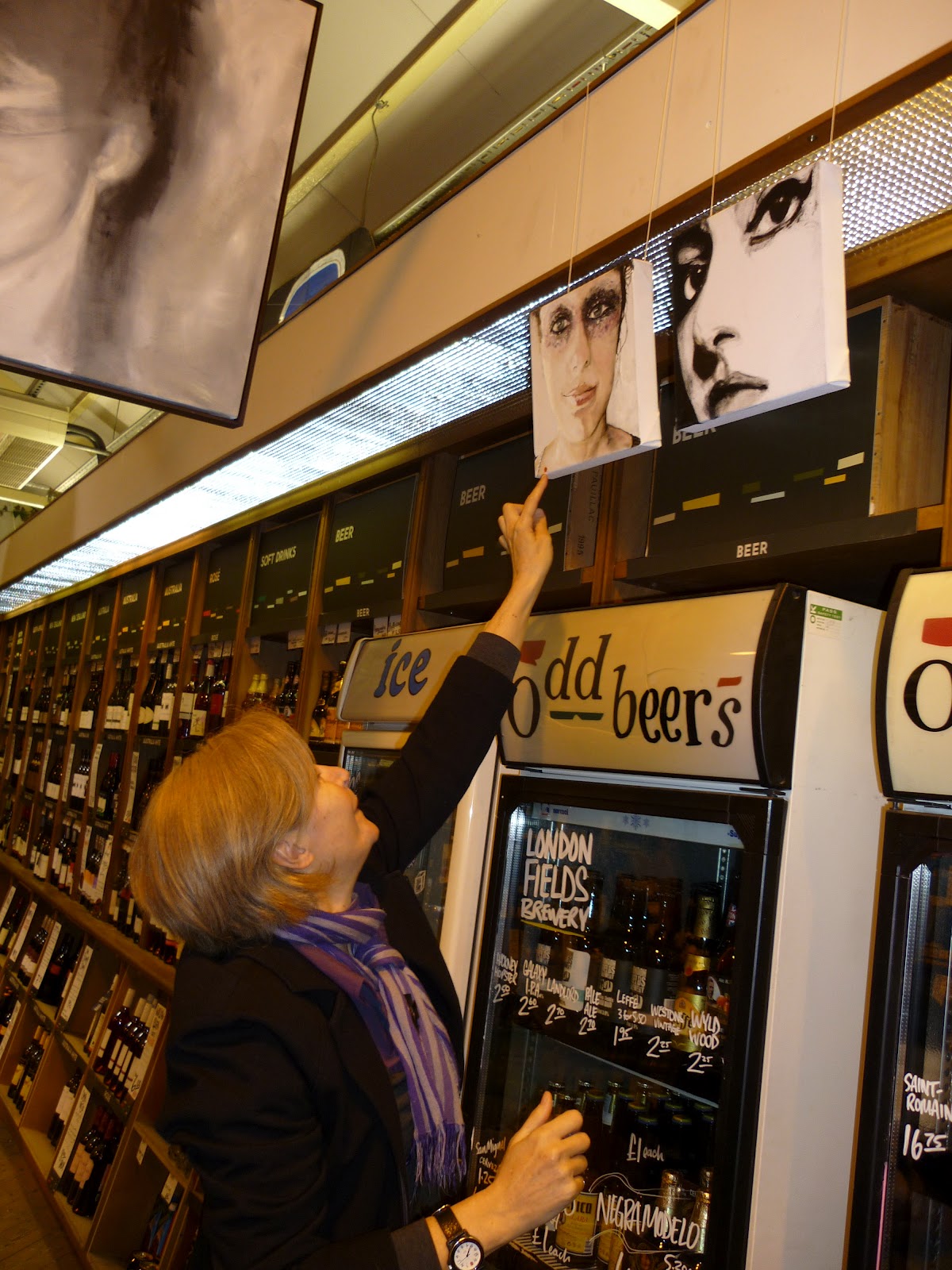
Me with Wendy Saunders whose wonderful paintingsN adorned the walls of Oddbins.
Barboot at The Haberdashery 


It's all in the detail: the light switch at Haberdashery Cafe loos

The nibbles kept the Englishman happy.
Live music
Next stop: Down for the Count at The Music Palace
This group of revellers showed us you're never too old to party. These OAP's (aged from 67 to 71!!!) treated us all to several professional sets of swing dancing. 
From left: Keith Madden, Anthony (who was recovering from a hip and back operation) and Linda Dalton and Marilyn Madden. 
Towards eleven o'clock the dance floor became crowded.
I am so tired from last night and suffering a little from my bad shoulder, so it's a mainly visual post today. Enough to say I thoroughly enjoyed the first night of the festival and cannot wait to see and do more over the weekend. With most events being free (The Music Palace charged us £4 each which was the only entrance fee we paid last night), this is truly recession busting fun.

Details of all Crouch End Festival events online here.