Showing posts with label Navy. Show all posts

Saturday, 9 June 2012

Oh to be in England - Part Three

This is an excerpt from my diary started just weeks after I married the Englishman and moved to the UK.


Previous posts can be found here.


19.08.1984


I have this problem with men. To me, a man, a husband, should be perfect in every way. He should understand me inside out and always say the right thing to calm me down or reassure me. Like a father. But the difference is that a child doesn't understand that a father has no idea what he is talking about. The child hasn't yet learned the emotional jargon which really says nothing at all.


I don't mean that The Englishman doesn't mean well or that he doesn't care when the things he says come out as platitudes. No, it's just that he's not perfect. 


See how far I've come?


I just wish that sometimes he would stop and think before he says things. Well, if he did, I guess I wouldn't love him so. Because I truly do, more than life itself. Of course he can't be perfect and I wouldn't want him to be a macho man telling me what to do. I'd hate that. 


You've guessed it - he's gone away to sea.


Early this morning when he was leaving I thought how tall he seems when he's about to go. I stood in the hall, still in my nightie, while he was dressed in his uniform, with his pusser's grip packed, the cap in his hand. He wrapped his arms around me and said, 'When I'm with you nothing can hurt me.'  Simple words that meant everything to me.

Wednesday, 6 June 2012

The Queen's Diamond Jubilee seen through Finnish eyes


The culmination of the long weekend of Jubilee celebrations here in London was the Queen's appearance on the balcony of Buckingham Palace yesterday, Tuesday the 5th June 2012.

A few months before this weekend, the Englishman and I won two tickets in a public ballot to watch the Queen and other Royals celebrate the special Jubilee Bank Holiday, on numbered seats in a stand outside Buckingham Palace. Initially I was more than thrilled. That is until I saw the programme: You weren't allowed to bring in any alcohol, nor large bags…and you had to be seated by 9 am in order to see the main procession and balcony appearance at 2.30 pm. That meant six hours of sitting outside, potentially being rained on (umbrellas were banned), without the champagne hamper I'd planned to prepare for the day. 

Still, although the Englishman had seen the Queen at close quarters during his naval career, I'd only seen the Royals on the telly. So it had to be worth the wait?

The queue snaked all away around the park.
For our shame we arrived very late (and without a packed lunch) at Buckingham Palace. Together with a few hundred others (I was glad we weren't the only ones!) we ended up queuing up for over an hour around St James' Park. Not a good start.

When we eventually took our seats in the stands opposite the Palace and the first military band entered our view, I suddenly felt very odd. What was I doing here? I am Finnish, not English. I don't belong here, I thought to myself as I sat amongst the Union Jack-clad spectators. Although I wasn't sorry I was there, at what surely must have been a historic occasion, I still felt a bit strange. There I was sporting a Union Jack scarf myself and waving a Union Flag. I would probably later sing God Save The Queen and Rule Britannia, very patriotic songs extolling the virtues of my adopted country. Yet, that was exactly the point: I lived in the UK but my passport still says I'm Finnish. I felt like I was on one hand betraying my motherland, on the other, pretending to be something I wasn't: British. 

I felt a complete fraud. 

It took a firm talking to from the Englishman, 'Just enjoy the day!' and a glass of fairly awful white wine (it was cold, that was its only virtue), and a pie (which was hot), bought from one of the food concessions, to stop me thinking too deeply about the meaning of everything.

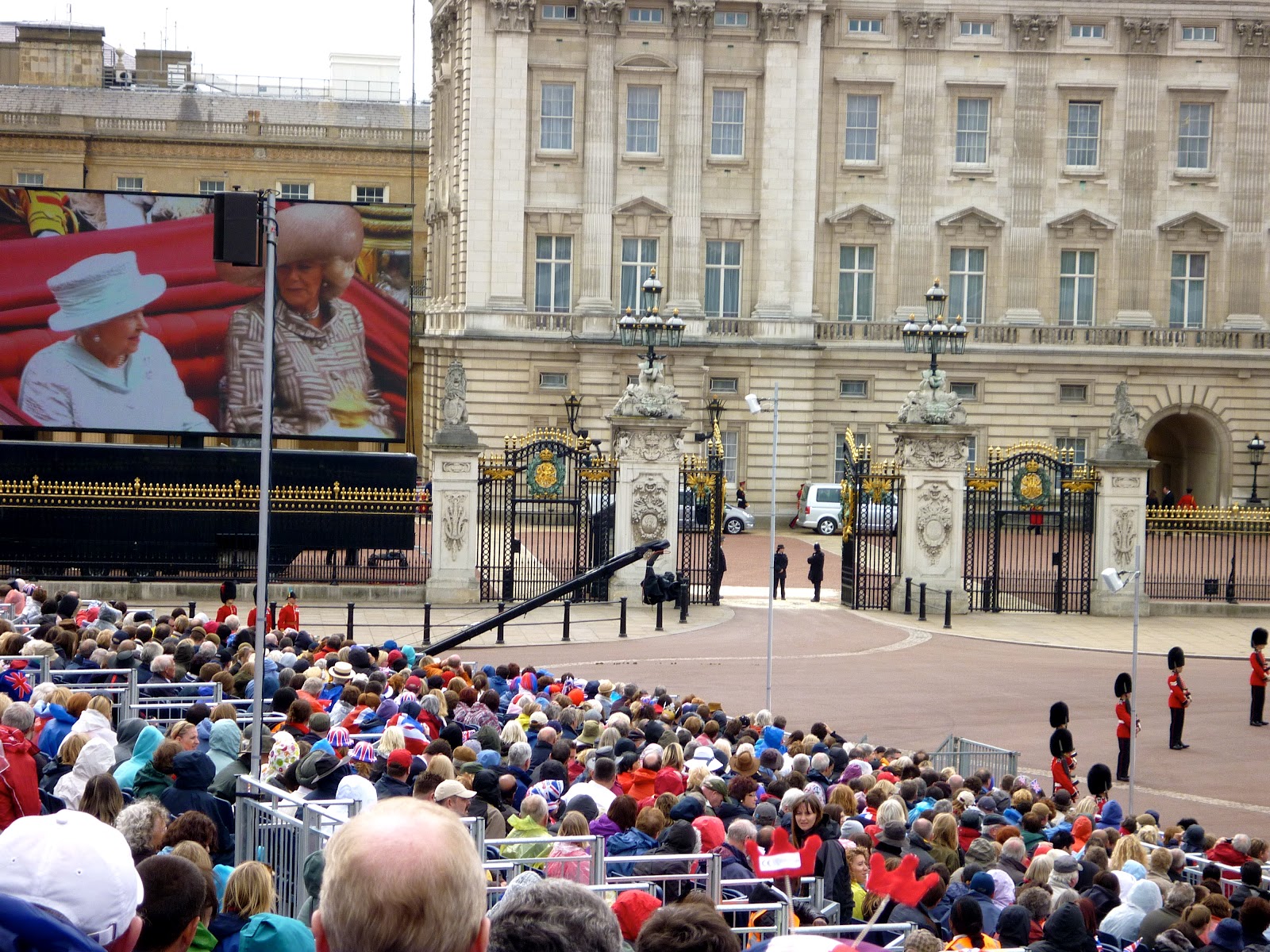
This was the view of Buckingham Palace from our seats.
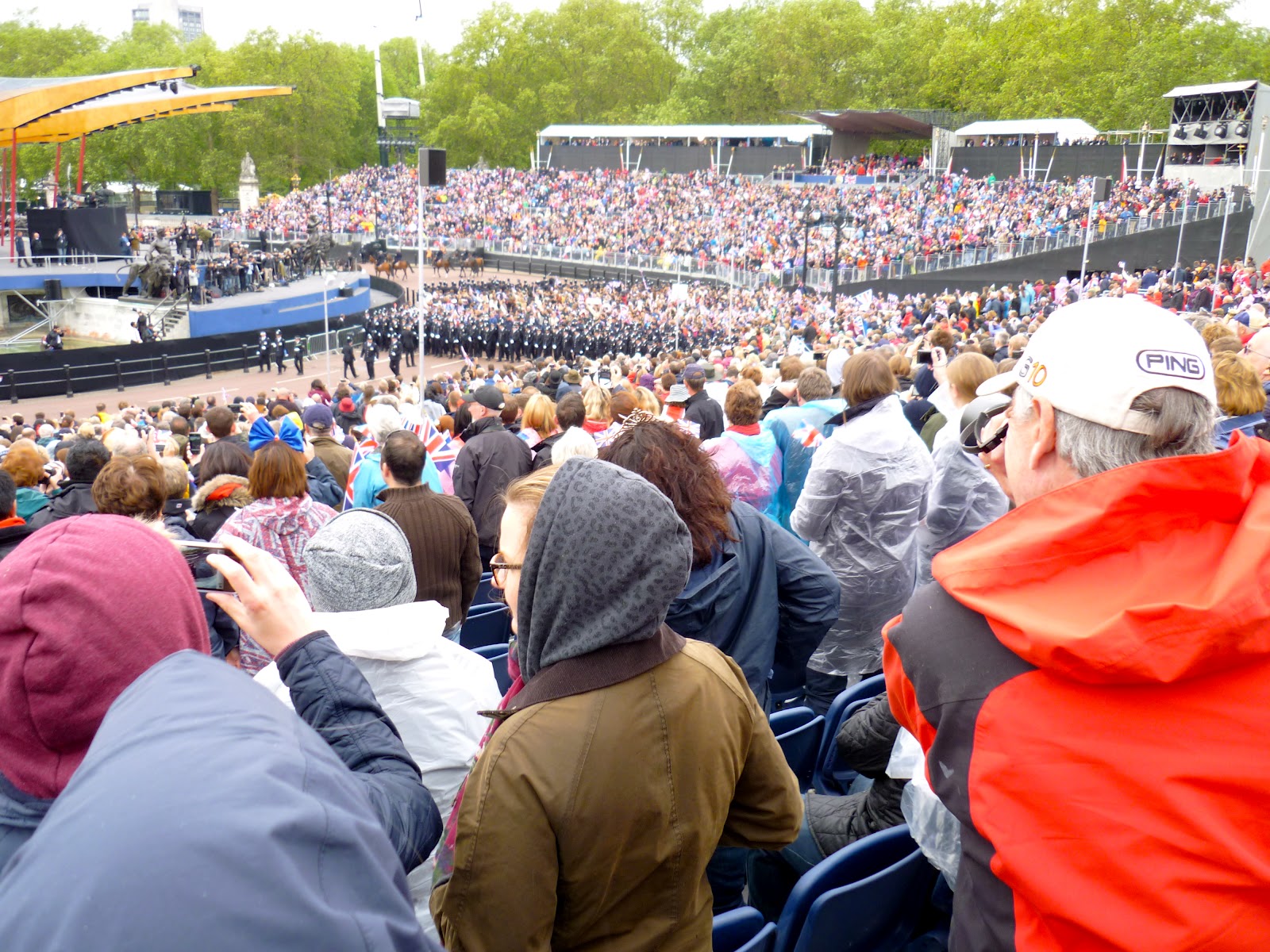
It would have been difficult not to get swept up by the atmosphere in any case, with or without the Englishman's succinct pep talk. The crowds, most dressed in Union Jack themed outfits, majority waving flags, all cheerful in spite of the cold and (later) rainy weather, patiently waited for their Queen to appear. To make the hours pass quickly, the crowds in the stands extracted fun from such simple things as watching Queen's Guards arrange themselves at equal distance along the Queen Victoria Memorial to line the route the Royal family would later take in their open top-top carriages. Before that we'd cheered each Horse Guard, each Royal Marines band, and replied in kind to a couple of policewomen waving flags at the crowd.

The Household Cavalry were very impressive.
These ladies had the right idea: lots of Union Jack motifs and the practicality of warm and water proof jackets!

Wasn't this lady stylish in her Union Jack dress?

I tried...
More military bands...
I think this lady had been to an event like this before: she was well prepared for the long wait.

The Queen's Guards kept the crowd entertained, although I don't think that was their actual brief.

The large screens to our left showed us the open top carriages were on their way to the Palace.
Then excitement nearly spilled over when the open-top carriages carrying the Queen, Prince Charles and Camilla in one, Princes William and Harry and Kate in another, rode past. Although they were so fast I hardly got to see the occupants!

Prince William, Kate and Price Harry. Really, look closely and you'll see they are there.
Then as the drizzle became rain, the crowd did Mexican waves while waiting for the Royals to appear on the Balcony opposite. At the same time a chill wind started blowing across the stands, and I was glad of my foresight in putting on winter wear for the early June day: a thermal vest, cashmere jumper, fleecy Barbour jacket and a raincoat…

When at last we saw the line of policemen move the crowds from Pall Mall towards the palace, we knew it was nearly time. But just watching the thousands of people, most dressed in red, blue and white, waving flags of various sizes, move slowly around the Queen Victoria Memorial was in itself a spectacle. The theory that crowds behave exactly like water certainly seemed true. The people even swirled like water when they came through the narrow passage between the two stands, slowly moving to either side of the central memorial, and then deciding to join either stream around the memorial. And everyone was so jolly - there was no trouble, just good humoured waving and cheering.

The crowds led in by a line of Bobbies from Pall Mall. 
As I sat there watching all the flags being frantically waved and the people enthusiastically chanting, I realised the real reason I love all this pomp and circumstance is the Englishman's former career in the Royal Navy. I have an acute sense of nostalgia for the marching bands, for the official protocol that an occasion such as a Diamond Jubilee celebration demands. It was a similar kind of world I first entered when I came to England all those years ago. Although obviously not mixing with Royals, there were a lot of official Royal Navy cocktail parties and balls, Remembrance Day services and officer's mess dinners, with each meal ending up with a toast to the Queen.

The Royal Family on the balcony. Again if you look closely enough..
But as I said before, I'd never seen the Queen IRL (in real life). When she, together with Prince Charles and Camilla, and Prince William and Kate, appeared on the balcony, they took my breath away. I was then very glad indeed I'd decided to enter that ballot. With the gun salute ringing behind us, the Queen waved, and I waved back.


The Red Arrows. 
Flags galore as we san God Save the Queen.
The day came to an end with a wonderful fly-past, followed by three cheers, led by the Queen's Guards, and joined in by the rest of the crowd - and by this foreign girl.

'You can apply for a British passport now,' said the Englishman when we (again!) queued up to leave the stands. As if being a naval wife for ten years, giving birth to two English citizens and living and working here for longer than I care to remember  hadn't qualified me already…

This displaced London life is strange indeed.

Tuesday, 25 October 2011

Barbour jackets

When I first moved to the UK in the 1980's, Barbour jackets were worn by what I can only call Hooray Henries and their female counterparts - or anyone aspiring to a certain social strata. A muddy Barbour was a must for every naval officer or naval wife at the annual Army v Navy rugby match at Twickenham. I remember one Navy chap once telling me in amazement how he'd taken his Barbour to Finland and 'the bloody thing froze'. He thought it could withstand temperatures of minus 10 or 20 Celsius and below, such was his belief in this old waxed jacket. I'm hoping a Barbour was not the reason for the spectacular failure of Captain Scott to win the race to the South Pole, but that's another discussion.

The waxed Barbour jackets of the eighties were often very worn out-looking. The dirtier and older they were, the better. To a Finn, whose mother had valued cleanliness and smart appearance above all, it seemed strange that a jacket that looked dirty and shabby would be worn as some kind of a badge of higher birth.

How things have changed. 

Last year when I was trying to find a smart jacket to wear for dog walking, I kept seeing the new (old?) Barbour International looking very smart on the pages of MyWardrobe.com and similar online fashion stores. Then I spotted a rail of them at Liberty's, tried one on and absolutely loved it. 

Here's me wearing my International on a trip to Scotland - it was perfect outerwear there.
There are downsides - the jacket can get very hot; it still doesn't breath very well. Similarly in very cold weather, it can be incredibly cold if you don't wear something sensible inside, like a Uniqlo HeatTech polo jumper or a cashmere cardigan. But, in its defense, my Barbour looks smart, the belt has a wonderfully slimming effect and I think it makes me look less like an angry old woman than, say, a boring old M&S parka would. (I'd like to point out that I shop at M&S quite a lot, so please no emails extolling the virtues of this old shopping institution - I only use the brand as a turn of phrase...phew). Besides, when my Barbour gets old and dirty, by all accounts my social standing should rise. 

Here's hoping.

I love my Barbour International so much that last week when shopping on Regent's Street with a good friend I found myself buying a new one. This time I wanted something more lightweight and tried on a quilted jacket, called Cavalary Polarquilt. It has no belt, but the back is cut slightly longer giving that all important small back region extra warmth. It's lined in soft fleece fabric, has a couple of pockets inside a couple on the outside. Its cut flatters the female shape and the navy colour  goes perfectly with my new blue theme. Since buying it, I’ve been wearing it almost every day.
My new jacket
My new Cavalary Polarquilt

The Barbour shop on Regent's Street was busy.

I loved the look of this Barbour Ladies Antique Brigade Jacket too
So here I am eating my words. Either Barbour has suddenly got smarter or I’ve gone over to the dark side. Take your pick.

Barbour Cavalary Polarquilt £139.95

(Something odd is going on with the fonts - apologies, the change in size is not intentional and doesn't show in the editing mode. Good old Blogger...)

Sunday, 29 November 2009

How I came to be in England - Part 30

I finished my drink in a few large gulps and asked the Englishman to get me another. We were leaning against the low balcony wall at the Dolphin mess. Music was flowing in from the rooms beyond, and people were moving in and out of the long, wide outdoor space overlooking the harbour mouth. Lights from Old Portsmouth opposite flickered against the dark water. Men were handsome in their pressed uniforms and polished boots, women glamorous in their long ball gowns.

‘Alright darling, what would you like?’ the Englishman asked with a puzzled look on his face. Ladies weren’t supposed to ask for a drink, they were supposed to wait to be asked, I thought. But I didn’t care. I saw the large beer glass in his hand and nodded towards it.

‘A pint? Are you sure?’

I said nothing, just looked at the Englishman.

‘I’ll get these, it’s my round,’ one of the other guys the Englishman had been talking to said and walked inside the noisy mess. He too was on the OPS course and the Englishman had also been to Dartmouth Naval College with him. ‘He’s really, really rich,’ the Englishman now whispered into my ear.

I should have been impressed, but all I could think about was what the old guy had said to me.

‘Who was that man I was talking to before,’ I said, trying to sound nonchalant. Or as if I was just making conversation.

‘Oh, he’s Commander SM. He sort of runs this place. Why, what did he say?’

But the Englishman didn’t really want to know. He wasn’t even looking at me. He was surveying the crowd. He waved his hand to some-one. The buzzing sound returned to my ears. A pretty girl wearing a salmon-coloured silk satin gown, clinched around her tiny waist with a huge bow at the back, was walking towards us. She was flanked by three men in uniform.

‘Hello, handsome,’ she said to the Englishman and kissed him on the cheek.

The Englishman introduced her. ‘This is the lovely Tash. The girl we were all in love with at Dartmouth.’

I managed a smile, although my ears were buzzing ever louder and my face seemed to have frozen into an unmoveable stare.

‘Nonsense,’ Tash said. She dipped her chin and looked up from under her thin eyebrows at the Englishman, feigning shyness.

The drinks arrived. As I was handed the pint, there was a silence. All eyes seemed to follow the glass of beer as it travelled from the tray to my hand.

‘Well, cheers,’ the Englishman said.

‘Cheers!’ all said in unison.

‘You know, I once knew an Australian girl who drank pints.’ One of Tash’s entourage said, nodding kindly to me.

‘Yes, and I’ve heard all the girls down under do!’ said the other.

‘I bet in Norway girls drink pints too?’ asked the Englishman’s friend who’d brought me the drink.

‘I don’t know,’ I said, ‘I’m from Finland.’

Another silence.

The Englishman took hold of my waist and said, ‘She can drink any of you under the table, though she hasn’t grown a beard yet.’

Laughter.

As usual, I thought, I’m the butt of a joke. I drank my beer quickly and when asked if I wanted another, I nodded.

By the time we sat down to our meal I was drunk, but all I wanted was to drink more. Occasionally the Englishman took my hand under the table, and asked if I was alright, but for the most part he laughed and talked loudly with the other people at our table. One of whom was the infamously lovely Tash, or Natasha, as the Englishman told me she was really called. ‘But everyone calls her Tash,’ he’d added.

She was sitting at the other side of the round table, attended to by a handsome naval officer either side of her. I felt sorry for a dark-haired girl who sat next to one of Tash’s adoring fans. Her purple dress had a deep cleavage, showing off her plump breasts. Occasionally I’d catch a guy around the table staring at her assets, but for the most part she was ignored, leaning across her partner to catch what Tash was saying.

As soon as the Englishman left my side, or I went to find the ladies’, other uniformed men approached me as if I was fair game. I thought somehow they’d guessed I was foreign. And that I was inferior, even desperate. Just like nurses. The Englishman had said there was a joke amongst young naval officers: ‘There are only two certainties in life: death and nurses.’

We weren’t home in the little house in Southsea until gone two o’clock. I was sick in the bathroom all night. Even after I’d brought up everything I’d eaten and drunk that night, I couldn’t sleep and sat at the edge of the bed. I felt like crying. The alarm clock on the side table said 5.30. Sleepily the Englishman put his head on my lap and said, ‘You got room spin?’

I looked at his dark eyes. ‘No.’

The Englishman closed his eyes and lay back against the pillow, ‘Come to bed then.’

I knew I should have done as the Englishman said. I should have lain beside him and slept. I should have waited until the morning to talk. It was a Saturday and we’d have the whole day together. Our last whole day before I was going back home to Helsinki. But, still drunk, I couldn’t help myself.

‘You’re never going to marry me, are you?’

There was no response. I turned around to see if he had gone back to sleep. If he’d dared…Anger surged inside me.

But the Englishman was lying on his back, eyes wide open, looking at the ceiling. I turned away from him again. I felt such rage at the Englishman for putting me through the night. He must have known what the people would be like, looking down their noses at me, a foreign girl daring to dream that an Englishman, a British Naval Officer, would ever marry her. Introducing me to a girl like Natasha, who I’d learned later in the evening was the daughter of an Admiral. Who’d be the perfect wife for my Englishman. She’d know how to behave at cocktail parties and naval dances. She’d not wear a dress that was obviously cheap and too revealing, or drink pints.

‘Well?’ I said.

‘Come here.’

Oh, how I wanted to go and lie next to the Englishman. To feel his strong arms around me, to put my head against his warm chest, to cry about everything in his embrace. But I couldn’t. I wasn’t going to be charmed by his empty words, by his warm kisses, or by sex. I had to be strong, and not be seduced. I had to know if we had a future.

‘No.’

I heard the Englishman sit up. He yawned loudly. I waited, with my back to him. I heard him breathe heavily, deliberately, in and out. ‘You know how much I love you.’

I turned around, ‘You don’t even mean that any more!’

‘But I do, darling, please, I’m so tired…you’ve been sick all night and…’

‘Oh yeah, it’s because I’m so uncivilised, foreign girls do that you know. Especially we Finns, we’re barely human, so we can’t really be trusted to attend fancy balls like tonight. Unladylike freaks, we drink pints of beer, not tiny glasses of wine like your lovely Tashes of this world.’

The Englishman got up. ‘What’s the matter with you?’ He looked angry, standing there in his boxers, his arms by his side, his fists tightly bunched.

Tears started to run down my face. I wiped them away with the back of my hand, swallowed hard and said, ‘That man, the Commander, he told me you knew you’d never be able to marry me.’

Silence.

The Englishman sat at the edge of the bed next to me. He put his arm around my shoulders, but I shook it off. I didn’t want his pity. I was shivering, thinking he’d soon tell me it wasn’t true. That he loved me and would marry me as soon as I wanted, that he’d never been in love with that pretty Tash, that he would die rather than lose me forever.

‘Look, I wasn’t going to tell you…’

‘Tell me what?’

The Englishman was looking down at his hands. I couldn’t see his face when he spoke. ‘I wrote to my Appointer and asked him if there was a problem with marrying some-one from a near-Communist country.’

I could hardly breathe. I stood up and shouted, ‘Finland is not a Communist country!’

‘I know that, but as far as the Navy is concerned…’

I was speechless.

The Englishman came up to me and took me into his arms. I was stiff in his embrace while he spoke.

‘I was told by some-one that marrying a girl….from…you know.’ The Englishman took a deep breath. ‘You’ve got to admit Finland is a bit different, so close to Soviet Union…anyway they told me my career in the Navy might be affected.’

I wriggled out of the Englishman’s grip, but he took hold of my arm and held onto it. ‘So I thought I’d ask directly, you know from the one person, my Appointer, who makes the decisions on my career.’

He stopped there.

I looked at his face. ‘So what did he tell you?’

‘I’m still waiting for his reply.’

Tuesday, 24 November 2009

How I came to be in England - Part 29


I arrived at Helsinki airport only twenty minutes before the flight to London was due to leave. I’d missed the bus from Espoo, where it stopped outside my Father’s house, by a whisker. The nasty old bus driver had, I was sure, seen me running towards it dragging my heavy suitcase, but nonetheless had driven off, leaving me breathlessly cursing the bloody man. He had something against me, even though I’d barely exchanged one word with him during the two years I’d been living with my Father. Then I’d just missed a tram and had to wait for twenty minutes for a Finnair bus at the terminal in Töölö.

‘The flight is full,’ the heavily tanned, red-haired woman at the check-in said. Her bright pink lipstick clashed with her colouring, and with the sky blue Finnair uniform.

‘Oh,’ I said, not really comprehending how I could be booked onto a flight and not have a seat reserved for me. An awful sensation came into my stomach: did this mean I’d miss the flight?

The woman revealed a set of white teeth, ‘You’ve been upgraded to Business Class.’

I looked at her. I was still feeling dizzy.

‘Have a good flight, Miss.’ She handed me the boarding pass, and nodded politely, as if I’d suddenly become a more important person.

I was wearing a pair of jeans and a t-shirt under a pale blue jumper. Everyone else in business class wore a suit, and I was the only woman in the whole compartment. Apart from the air hostesses of course, who I felt sure knew I didn’t belong there.

The plane was absolutely full. I had a window seat next to an older Finnish man, who started talking to me as soon as we took off. ‘Going to London for work?’

‘No, I’m a student, going to see a friend.’

‘Do you study at Helsinki University?’ The man smiled to me in a kindly way, like a father to a daughter. I guessed his children were my age.

‘No, at Hanken, The Swedish School of Economics.’

This really seemed to impress the man, ‘Oh!’ he said.

I turned towards the window. We were hovering above white clouds. The air hostess brought us a meal and I asked for orange juice. I looked at my watch: only 2 hours fifteen minutes until we’d land at Heathrow and see my Englishman.

‘You must be excited about the elections then?’ the man said. He was chewing a piece of chicken and I wasn’t sure I’d heard correctly.

‘The elections?’

‘Yes, Margaret Thatcher! You must like her radical views on the Economy?’

I looked at the man. His thin hair was going grey at the temples. I had no idea of the politics of the newly re-elected British Prime Minister, only that she was right-wing. I agreed with everything the man said, trying to avoid further questions. Eventually he gave up when I dug the latest Graham Greene novel I’d borrowed from the British Council out of my handbag.

The Englishman was waiting for me with a dark red rose in his hand. He kissed me for a long, long time. I’d forgotten how he smelled of cigarettes and aftershave. His mouth tasted minty. I felt breathless, my heart beat so hard I felt sure everyone around us must have heard it.

The new car was on the second level of a concrete parking lot. It was a grey and black Ford Fiesta and looked dull compared to his old yellow Spitfire, but the Englishman told me the sports car was always breaking down. We headed down to Portsmouth and I was struck by the bright colour of the fields we passed. It was a hot June day. Some farmers were already cutting their crops of hay. In Finland we didn’t start doing that until at least a month later. Summer was so much further ahead here, I thought, and wished I could stay in England forever.

‘You didn’t forget your dress, did you?’ The Englishman said.

‘Sorry?’

‘For the Dolphin Summer Ball?’

‘Yes, I remembered.’

‘Great. It’ll be good fun!’

The Englishman had told me about the ball which was held each summer at the submarine base in Portsmouth. I was nervous about meeting a new set of friends. I’d brought the same dress, (the only ball gown I owned) that I’d worn to the University Ball in Helsinki year and a half ago. I was afraid it’d be far too ordinary-looking. I was sure the other girls would be wearing designer gowns, not one that was made by a friend from cheap material.

We were the only ones out of the old group of navy friends who that summer stayed in the terraced house in Southsea. It belonged to the Englishman’s best mate who was in Northern Ireland. Another friend, who’d lived there two years ago when I’d been to stay for the first time, was working for NATO in Brussels and another was in Faslane, where my Englishman had just ‘escaped’ from.

Each morning after the Englishman left for work, looking handsome in his uniform, I walked down to the shops at the end of our street. I cooked Finnish dishes, searching for the right ingredients at the small butchers and greengrocers.

I made Karelian stew out of diced beef, pork and lamb’s kidneys, pea soup from a hock of ham and dried peas, fish chowder from cod and new potatoes. I struggled to work the gas oven and hob in the little kitchen at the back of the house, often burning my fingers with matches. It seemed so old-fashioned and dangerous to cook with gas, but the Englishman told me it was much better and cheaper than electric.

The Summer Ball was two days before I was due to return to Helsinki. I’d been dreading it, trying not to think about it. The Englishman wore his summer dress jacket, white with the gold lapels. When he was ready and I was still getting dressed, he kissed me on the cheek and said, ‘No rush, darling. I’ll go and fix us G & T’s’

I took a deep breath and looked at myself in the mirror. I didn’t want to wear too much make-up but I looked so pale, I added more blush to my cheeks. It was another hot summer’s evening. It had only rained once during the whole two weeks I’d spent in the house in Southsea. But tonight I felt cold. I couldn’t understand why I was so nervous about this evening. Was it the fear of perhaps seeing the girl, the Englishman’s ‘accident’? We hadn’t discussed the past, or the future. But still, she had to be somewhere. She had to be someone. The two weeks had gone by in blissful haze of domesticity. It was only now, when I knew we had to go out together, it occurred to me that I still didn’t know if we really were a proper couple. I’d again not been brave enough to talk about anything important with the Englishman and I certainly couldn’t do it now.

The Englishman drove us to the jetty in HMS Vernon, where we boarded a pass-boat over to Gosport on the other side of the harbour. The Englishman went in first, then gave me his hand to guide me onto the small vessel. I felt as if I’d entered the last century when we sat down next two other couples. The ladies in their evening gowns, made out of luxurious velvet and silk, wearing long satin gloves, smiled. The men took of their caps and nodded to me.

‘Good evening,’ one said.

‘Good evening,’ I replied. It was still warm, but I was shivering.

The Englishman sat next to me and put his arm around my shoulders. ‘You OK?’

‘Are Lucinda and Richard going to be there?’

The Englishman laughed. ‘No, I don’t think you’ll know anyone, but don’t worry I’ll look after you,’ he whispered into my ear as the loud engine of the boat started and we headed towards the other shore.

The Dolphin submarine school knew how to organise a party. There were different areas for food, dancing or just socialising. There was a disco, a Caribbean steel band, and a live group called ‘The Smugglers’, who played old-fashioned music from the Seventies.

The Englishman led me to a vast balcony overlooking Old Portsmouth and Southsea. He handed me a drink and introduced me to a string of his friends and their wives or girlfriends. As soon as they told me their names, I forgot them. I couldn’t follow the conversation over the music which flowed from the different rooms inside. Everyone was happy, the men were making jokes and the women laughed out loud. I smiled too, trying to pretend I’d understood the punch lines.

‘You stay here, I’m going to check where we’re sitting for supper,’ The Englishman said and left.

A slightly older man, who seemed to be on his own, came to stand next to me. He had watery eyes and thinning pale hair. His jacket had several gold rings on it so I guessed he must be more senior than the Englishman.

‘He’s not given you a set of Dolphins yet then?’ he said, bending down to look at the top of my dress.

I placed a hand over the low-cut cleavage. I felt very exposed, and cursed my decision not to buy a proper ball gown after all. Mine was made of very thin fabric. It had narrow straps, making it impossible to wear a bra. I’d told the Englishman I thought it too revealing but he’d just laughed and said I looked very good in it.

‘Sorry, I don’t understand?’ I said. The man pointed at a small brooch-like pin on his uniform jacket.

‘Oh. No, he hasn’t.’

The Englishman had told me about the Dolphins, the emblem of the submarine service. Once you passed your exams and had done the sea time in a boat, you had to earn your Dolphins by catching the pin between your teeth from a glass of rum. I remembered how proud he’d sounded when he told me about the ceremony. But I didn’t realise the ladies could have them too.

The man laughed at my confusion and said, ‘I don’t suppose he’s told you he can’t marry you either?’

I looked at the man’s red, flushed face.

Just then the Englishman reappeared by my side. ‘C’mon darling, there’s some-one I want you to meet.’

I was still staring at the man.

‘Excuse us, Sir,’ the Englishman said to him and led me away.

My ears were ringing. The Englishman took me to the end of the long balcony. I saw how the lights from the other side of the harbour reflected against the dark water. The floor beneath me felt uneven, as if I was still on the boat. Or floating in the water. Noises around me seemed muffled. Had I gone deaf? The Englishman rested one hand on my waist, drinking a pint of beer with the other. He was half-leaning over the low balcony wall, talking to three other officers, who’d appeared from no-where. I wondered if I’d met them before. Their laughter seemed to come from somewhere far, far away.

I shook my head and slowly regained my hearing.

Wednesday, 30 September 2009

How I came to be in England – Part 21

The same Sunday night in late June 1982 I'd said my tearless goodbye to the Englishman I started to be sick. When two days later I still couldn't keep a glass of boiled cooled water inside me, I phoned the student health service in Töölö, in the centre of Helsinki. They told me to come and see them straight away.

The doctor wore a white coat. He had round gold rimmed glasses and grey thinning hair. I sat on his examination table while he took my temperature, tapped my knees, looked into my eyes, felt my glands and my stomach. I hurt all over, but I was so tired from two days and nights of diarrhea and throwing up, I had no energy to even utter a sound. He took two steps back and wrote something on his notes.

‘I think you might have salmonella poisoning.’

I nodded. All I wanted was to be allowed to sleep. The doctor regarded me for a moment. ‘Did someone bring you here?’

‘No.’ I suddenly realised it was the journey from Espoo with a bus, walk to the tram stop and then another long walk to the health centre that had exhausted me.

'You need go to bed, take these and sip a mixture of this,’ he gave me a packet of tablets and a few sachets of something. ‘If you don’t improve within the next 24 hours, get an ambulance to take you to hospital.’ The doctor had kind eyes. 'Can you phone someone to come and get you?' He nodded at his desk phone. ‘You can use that.’

I couldn’t think who to phone. My friend was traveling around Europe for the summer and my mother and sister were in Stockholm. I hadn’t seen my father since Midsummer, didn't know if he was back at work. I dug in my handbag for my address book.

‘Yes?’

‘It’s me. I’m not very well, I’m in Töölö Health Centre and the doctor said I should have someone to pick me up.’

‘Oh.’

‘There’s no-one else I can call.’

‘Can’t you take a taxi?’

I was close to tears. My father sounded so irritable.

‘I haven’t got any money.’

My Father inhaled loudly. ‘Of course not,’ he said dryly. ‘What’s wrong with you anyway?’

When I told him he said he’d come and meet me at home and pay for my taxi there. ‘I don’t really want to catch it so I’ll stay away until you're better.’

I was ill for two weeks. I slept for most of it and had nightmares about sinking U-boats, nuclear mushroom clouds and men in uniform laughing at the suffering women and children. I didn’t go anywhere, I didn’t see anybody. My father phoned half way through the second week and when he heard I was still not able to eat anything, he told me he’d stay away for another week just to be safe. ‘You do that,’ I said and decided I would never forgive him for abandoning me like this. My mother didn't know how ill I was. She was too far away anyway.

During those strange summer weeks in 1982 I didn’t hear from the Englishman. There was no letter, or phone call. I didn’t even know if he had reached his new nuclear submarine in Scotland, or whether he was away at sea, or on dry land at the base. I didn’t know if we were still together, or if his disastrous week in Helsinki had finished our two year romance. It was strange, but I wasn’t sure I cared one way or the other. Not worrying about him, not longing for his touch, hearing his voice, or reading his letters seemed oddly liberating.

When I returned to my internship at the bank in mid July, I’d lost 10 kilos in weight. All my clothes hung off me and I loved it. Something good had come out of the suffering. The nice doctor at the health centre had signed me off the sickness register and given me a note to take to my bank manger. ‘I was quite worried about you, young lady,’ he said and smiled. Why couldn’t my father be worried about me if the doctor who doesn’t even know me was?

Finally three weeks and three days after the Englishman had returned home, he called.

‘You OK?’ he asked after we’d said the usual hellos. I noticed he hadn’t said he missed me.

I told him about the salmonella poisoning. ‘You didn’t get it?’

‘No.’

Hearing the Englishman’s voice I realised I was angry with him. Angry for spoiling our week together, angry for being an officer in the Royal Navy, angry for not being here with me, angry for not understanding how angry I felt. I said nothing.

‘So…’ he said.

‘Yes?’ I said.

‘You OK now, right?’ he tried again.

‘Oh yes.’

‘Right.’

I’d had enough. ‘Look, I’ve made a decision.’

He said nothing. I could hear noises in the background. Was he in a pub? ‘Where are you phoning from?’

‘Oh, the mess. I couldn’t get away, we’ve been at sea all this time and I couldn’t even get a letter to you.’

‘Oh.’

‘Hold on,’ he said and I heard him talk to someone. ‘Five minutes,’ I heard him say.

Now there was a time limit, of course. Foreign calls were expensive. ‘Anyway, as I was saying, I’ve decided it’s probably best if we stop this.’

‘What?’ the Englishman sounded absentminded, then his voice sharpened. ‘What did you say?’

I inhaled deeply and repeated my words, even though as I said them a strange lump formed on my chest, as if a heavy weight had been placed against it. It made me struggle for breath.

‘You can’t say that.’

‘I just have,’ I said breathlessly.

There was a silence. ‘Oh my God.’ He sounded truly shocked and I felt dizzy. Surely I was only saying what he thought too? Or…?

‘We never see each other. I’ve got another year at uni. How am I going to get a job in England when I’m finished? And you’re always away at sea. And…’ Tears were running down my face. I sniffled.

There were more voices behind the Englishman. ‘Look, I have to go, but please don’t cry. We have to talk about this, OK? Can I call you tomorrow night? Please.’

I could never say no to the Englishman.

With shaking hands I replaced the heavy telephone receiver on the hook and sat down on the floor. My heart was racing against my rib cage, it felt as if the lump had now engorged and was crushing the whole of my upper body with its weight. My heart had no space to beat and no air was reaching my lungs. What had I done? What if the Englishman didn’t call back, what if having thought about it he knew I was right? Our relationship was doomed, our future together hopeless. I put my head in my hands and howled like an animal.

Friday, 28 August 2009

How I came to be in England - Part 18

When the Englishman left after his week long visit to see me in Helsinki in February 1982, I was heart broken, but didn't cry. Clutching the red rose he’d again bought me at the airport I sat in the posh Finnair bus on my way back my father’s place in Espoo, full of determination to do well in my studies at the School of Economics. I was enjoying my new subjects. Learning about political systems, about the workings of the labour market, about the intricacies of parliamentary democracy was a pleasure. And I was safe in the knowledge that the Englishman was serious about our relationship. I kept thinking: the sooner I get my degree, the sooner we can be together. Though we hadn't discussed it, I knew I’d have to move to England. Not a big deal. I’d moved countries before and didn't want to stay in Finland.

The house was cold and quiet when I got back. My father was at home, sitting in a dark room with a bottle of Koskenkorva vodka next to him. ‘Gone then, has he?’ he asked. I heard the sarcasm in his voice and knew better than to answer. It was his Jekyll and Hyde moments that I feared most, so I went into my room, locked the door and put on the latest cassette the Englishman had brought with him. I decided to read Karl Marx’s Das Kapital for an assignment due in the following week.

As spring arrived and the snow slowly melted in the small patch of land outside our living room, my work load at the School of Economics grew. My friend was still very upset about the Hulk and had immersed herself fully in her studies. She’d lent me all of her Doris Lessing books and I’d fallen in love with her writing, as well as her principles.

I found an old bike in the communal cellar next to the sauna compartment my father said I could use. When the weather was a little warmer I cycled to see an old school friend who’d started at the School of Economics a year after me. She lived with her parents a kilometre away and we sat in her bedroom and talked about university, men and fathers. Occasionally I’d go out but had little money or time. The Englishman wrote as often as he could, and phoned when he wasn't at sea. Which was more and more rarely.

During that spring I also spent a lot of time at the School of Economics library, reading or borrowing books too expensive to buy. It was situated at the top of a modern office building, with one lift constantly ferrying students up and down. The staircase, which we only used when absolutely necessary, was the library smoking room, whilst the library was the meat market. Much like a book you needed, you could pick up a date there for the evening. Needless to say, the year 4 boys spent most of their afternoons in the library. But I was invisible to them now. The boy who’d asked me out ignored me studiously. If I passed the desk which his legs were sprawled on, his eyes pretending to examine the text in a book held high above his eyes, he’d not look at me. But if I turned around abruptly, I’d catch him assessing my rear.

What did I care about him, the Englishman had proposed to me! And I’d see him in April. This time we were going to meet in Stockholm, where my sister had promised us her flat for the week. I couldn't wait to show the Englishman my second home town. Besides, Spring would be so much further along there. The city would be filled with greenery, with Easter decorations and sunshine. The very opposite of the dreary, grey, cold, windy Helsinki.


On the 3rd of April 1982 I got a phone call at 3 am. ‘We've declared war.’ The Englishman’s voice sounded grave.

‘I know.’ I’d seen it on the news, how the mighty United Kingdom, a former colonial power, had been humiliated by a small South American dictatorship. But to declare war, in the 1980’s?

‘And on my birthday!’

I realised the Englishman had had a drink. ‘And they've cancelled all leave.’

I sat down on my bed. ‘Does that mean..?’

‘Yes, I can’t come to Stockholm.’

The Falkland Islands, a small group of islands I’d never heard of, somewhere off the coast of Argentina was spoiling my plans to see the Englishman. How could this be? Absurdly I asked, ‘What about the flight?’

‘Act of War is Force Majeure. I’m in the Royal Navy, I’ll get all my money back.’

Act of War. That was all I could think about. ‘Are you…?’

There was a silence at the other end.

‘I mean, are they going to send you to…’

The Englishman interrupted me. ‘Please don’t ask. I can’t say.’

Thursday, 6 August 2009

How I came to be in England - Part 13

My father, who had two daughters, called me 'My Best Girl.' As I grew up his obvious favouritism became a burden to me, rather than a source of pride. So when my parents finally split up after years of fighting, it was a relief to both of their two daughters.

Our parents gave us a choice of which side to take. My sister was fifteen and I was thirteen. They sat us on our plush velveteen sofa and asked us each in turn who we wanted live with. My father didn’t take the rejection well. ‘You’ve made your bed. There’s no more money from me.’ He stormed out. That night he came home drunk again.

But in 1981 I had no choice but to go and live with my father. In spite of the threats, over the last few years he occasionally invited his two daughters to lunch. As we parted, he always handed over a few dark purple 100-mark notes. When I told him about the School of Economics, he gave me a small allowance. And when I eventually phoned him from Stockholm, he promised me a temporary home in his house in Espoo, a town of suburbs just outside Helsinki. Of course I hesitated, but my mother said, ‘It’s about time he took some responsibility for his daughters.’

The Englishman on the phone from Scotland couldn’t understand what the problem was, ‘But he’s your father?’

I couldn’t tell him about the drinking or the violence.

At the School of Economics, I was greeted with a hug from my friend. ‘Coming back to study is absolutely the best decision you could've made.’

The blonde haired woman at the students’ advisory office agreed. ‘Why don’t you change your subject? Commercial Law is a difficult one to specialise in,’ she remarked, ‘especially as Swedish is not your mother tongue.’ Her kind eyes were fixed on me. ‘The next Committee meeting is early December. If you get two exam passes by then, we can re-approve your grant.’

So I became a student of Political Science at the School of Economics. The department was small and homely. We studied the theories of Karl Marx as well as those of Keynes. My horizons were widened. While the other students at the university learned how to make money, or account for it, our department taught us the principles behind the desire for wealth and power.

At the house in Espoo, my father got drunk only rarely now. He’d given up his bedroom for me and was mostly staying over at his new girlfriend’s flat in Töölö. I cooked for him when he was at home, and when he was in a good mood, he made Gravad Lax.

While I tried to forget about the Englishman, his letters wouldn’t allow me to. He wrote to me at least once a week and called when he was on dry land. Most often he was away with the submarine, to unknown destinations, for weeks on end. Then one night, I was woken up with a phone call.

‘We’ve just sailed in, and I’ve been told I can take leave for Christmas. Can you come to England?’

My grant came through in December and if I continued to live with my father, I’d be able to afford the fare. I told the Englishman I'd think about it, but I knew what my decision would be.

My friend at university shook her head. ‘Are you sure that’s wise? You remember what happened last time you came home from England?’ We were standing in the semi darkness of the student’s union disco in centre of Helsinki. We’d started going out a lot, most often to Monday night ‘Ladies Nights’ at the club when girls were let in free. The disco was full of students from all the Helsinki universities, but mostly students from the School of Economics. The gang of year 4 guys were always there, and I’d see them laughing and gazing at me and my friend. I wondered what would've happened if I'd agreed to go with the dark haired one. Would I now be arm in arm with him instead a tall red-haired girl he was with that week.

‘Nonsense,’ my friend remarked, ‘you know exactly what would have happened. He would have fucked you and that’s that. It’s what they do: as many as possible in as little time as possible.’

I laughed. But was this what all men were like? Was the Englishman like that too? Was he only so loving and seemingly committed to me because he was lonely up in Faslane, or Faslavatory, as he called it? Where he said there were no pubs or clubs. In other words, no places to meet girls in?

When I got home that night, I got another call. 'Well, are we going to meet up at Christmas?'
'Of course we are.'

I could hear the Englishman take a deep breath, 'Only two weeks!'