Showing posts with label cooking. Show all posts

Wednesday, 25 March 2015

Easy Vegan Food: Lentil, avocado and mint salad

When my daughter said she was going to be Vegan for the whole of January, I was a little shocked, but then thought it would be fun to try it out. After the meat excesses of Christmas, it'd do me and the Englishman good too to cut down on animal fats.

Trying to be healthy in January is a bit of a tradition in our household anyway - we cut down on alcohol and eat more greens etc. For a few years we even managed to be completely dry (alcohol-free) in January. But somehow that doesn't happen any more...

Anyway, I've flirted with vegetarianism for years, though only completely managing to eat a meat-free diet for about six weeks in year dot, when the Englishman was away at sea. He jokes that I am part-time vegetarian who enjoys the occasional rare (blue, actually) steak. True enough, that.

So...you might have noticed it's now March and I'm writing about easy Vegan recipes...the diet suited Daughter so much that she decide to remain animal-free for the foreseeable. But I would be lying if I didn't admit to sometimes tearing my hair out, trying to think of what food to make for all of us.

(By the way, before I get complaints from the other people in my household - I don't by any means carry the burden of providing the family with sustenance every day - we all enjoy cooking and take turns).

Luckily for me, my sister, The Great Cook, came to stay with us in January. Her daughter is also recently Vegan, so she had a great many recipes under her hat. But because my Big Sis has been working in the food trade for all her career, the recipes she cooked for us seemed terribly complicated.  When Big Sis left, I felt completely at loss on what to cook for Daughter and the Englishman. Because we are all so busy, I didn't want us to have our evening meals separately - the recipes needed to satisfy meat eaters as well as Vegan Daughter.

So I turned to vegetarian pasta dishes, but after a while this too became a little monotonous. Slowly, however, we've together as a family built up a repertoire of simple supper dishes which you can throw together when exhausted from work and the London commute, and I thought I'd share with you some of these easy Vegan dishes.


Lentil, Avocado and Mint Salad

I made this salad up last night out of ingredients that I found in the cupboard, and it tasted so good that I thought I'd share the recipe with you.

I love puy lentils, and they, like avocado, are a rich in numerous essential nutrients, such as fibre and protein. This recipe was just enough for three hungry people, and I served it with baked sweet potatoes.

Ingredients:

150 g Puy lentils
2 ripe Avocados
1 red onion, cut in half and finely sliced
150 ml red wine vinegar
1 tablespoon of extra virgin olive oil
1 lemon - juice and rind
sprigs of fresh mint

To serve:

I head of little gem chopped
a handful of watercress
Salt and pepper to season

Method:

Wash the lentils and place in a saucepan. Cover with plenty of cold water and bring to boil. Cook on  allow heat for abut 40 minutes (or according to packet instructions).

While the lentils are cooking, place the slices of the onion in a bowl and pour over the red wine vinegar so that the slices are just covered. The onions are gently pickled in the vinegar while the lentils are cooking - they need at east half an hour. You'd be amazed how lovely and mild the red onion becomes in such a short time.

When the lentils are soft with still a little bite to them, drain them and place back in the saucepan (off the heat). Pour over the olive oil and squeeze over the juice of the lemon and grate some of the rind in too. Season with salt and pepper.

Because I was serving baked sweet potatoes with the salad, I had to wait for about ten minutes for them to cook, during which time the lentils cooled slightly.

Add the avocado flesh, cut out with a small spoon into roundish shapes, to the lentils (Though it doesn't really matter what shape you make them). Mix gently with the lentils and add the fresh mint, finely chopped. (If you can't wait for the lentils to cool, add the chopped mint last on top of the salad, otherwise it'll quickly wilt & turn dark mixed with the hot lentils).

Spread the chopped little gem lettuce onto a plate, and pile the lentils and avocado on top. Arrange the watercress around the lentil mixture, and finally drain the red onion slices and arrange around the dish.

And enjoy!

Monday, 25 August 2014

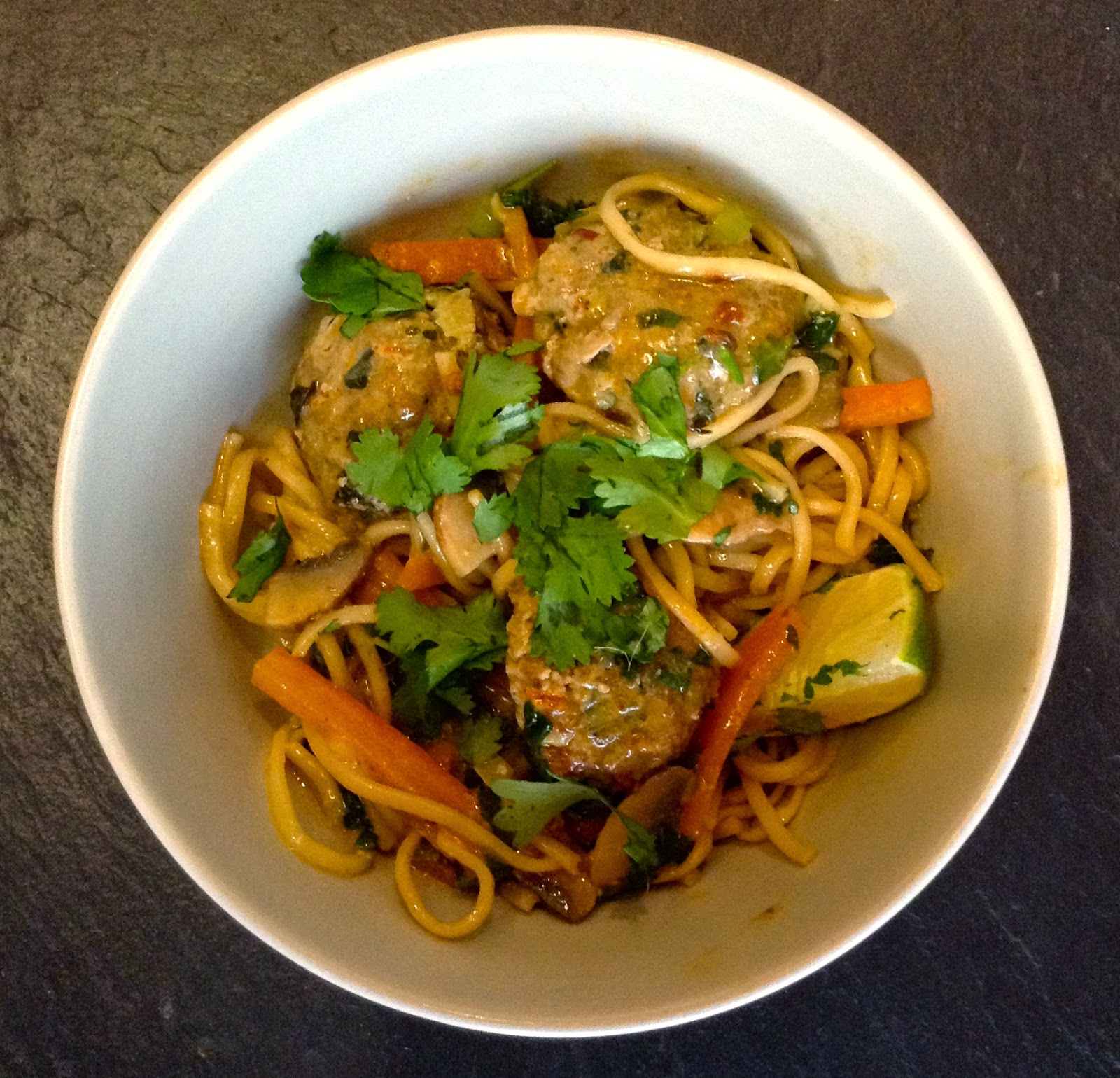
Thai style pork meatballs with noodles in a fragrant broth

For some reason I've been craving Thai flavoured pork meatballs for some time, and I love noodles, so combining red curry paste and herbs, I made up this recipe. It was so good and popular with Daughter and The Englishman, I thought I'd share it with you.

The meatballs can be cooked in the oven on a non-stick oven tray, or be fried in a heavy based pan (in which case roll the meatballs in little plain flour before frying in hot vegetable oil).

For the meatballs you need:

  • 500 grammes minced pork
  • 1 egg
  • 3 water chestnuts, chopped
  • 2-3 spring onions
  • handful of fresh coriander
  • 1 red chilli (seeds removed)
  • I glove of garlic crushed
  • 1 cm piece of ginger, peeled and sliced
  • 2 teaspoons of sesame oil 
  • 1 tablespoon of dark soy sauce
  • 2 teaspoon of oyster sauce
Blitz spring onion, coriander, chilli, chopped water chestnuts, garlic and ginger in a food processor until finely chopped. 

Mix the minced pork with all the ingredients including the egg and form into about 16 balls. Bake in 180 c oven for 20 minutes. (Or coat in flour and fry in small batches.)

For the noodles in fragrant broth you need:

  • one teaspoon vegetable oil
  • 1.5 tablespoon red Thai curry paste,
  • tin of coconut milk
  • 1.5 litres of vegetable stock
  • 250 grammes packet of medium egg noodles
  • 1 teaspoon of brown sugar
  • A carrot cut into matchsticks
  • 3 chestnut mushrooms thinly sliced
  • Spring onion, cut in half and finely sliced
  • Handful of coriander, finely chopped
  • Lime juice to taste
  • Thai basil, finely chopped
While the pork meatballs are cooking, start preparing the broth and noodles. Heat oil in a large pan and fry the red Thai red curry paste for a minute or two until there's a strong scent of spices. Add the coconut milk and vegetable stock. When the broth comes to boil, let it bubble for a couple of minutes. Next, add carrots and cook for 5-10 minutes according to how small the matchsticks are. Add mushrooms and cook for a further two minutes. Finally add the noodles and cook according to packet instructions (mine took 4 minutes).

When the meatballs are cooked through, remove from the oven, cover with foil and rest for a few minutes. Add them to the broth, sprinkle with some fresh coriander and a squeeze of lime juice. Serve with more lime wedges.


Wednesday, 30 July 2014

A New Finnish Cookbook, Kuura, plus an Exclusive Recipe

Sini signing her cookbooks at the Kuura launch at
the Finnish Ambassador's Residence
The flavours of Nordic cuisine have become ever more popular in recent years as Scandinavian design, lifestyle and drama have penetrated the public consciousness in the United Kingdom.

In spite of its apparent ease and simplicity, cooking the Nordic way with ingredients available in Britain can be tricky. To help navigate the cross-cultural gastronomy, Sini Kiialainen, Chef for the Finnish Ambassador to London, has created Kuura, a Nordic cookbook designed for the British audience.

‘I began writing the book after receiving many requests for my recipes, and I’m very proud of how it turned out,’ says Sini Kiialainen.


Born in Finland, Sini moved to London at the age of 18. She has made an impressive 12-year career on the London restaurant scene, and Kuura draws its inspiration from Sini’s extensive work for a variety of diplomatic occasions, be it intimate meetings over coffee, luncheons, formal dinners or large receptions.

For me the most inspired recipe is the ‘posh’ mini meat and rice pasties (lihapiirakka). But these lihapiirakka are million miles away from some of the worst examples of this classic street food that you just must have after a night out in Finland, when some drinks have been consumed...you know the kind of moment! Having tasted Sini's pasties at the launch of Kuura, I can vouch for their authentic and excellent flavour.


‘Every time I see that picture I want to make the meat and rice pasties again,’ Sini said when we chatted about her new book at the Finn-Guild office yesterday.

I love lihapiirakka in all their incarnations (even the greasy ones sold from a van), but the Englishman has a love/hate relationship with this Finnish version of the late-night kebab. He believes a drunk and hungry Scot, while visiting Finland, must’ve invented the deep-fried savoury pasties. (This is a reference to deep-fried Mars bars, I think). When I told him that I’d tasted a posh version, he couldn’t quite believe it.  

So to prove a point, here it is – exclusively on my blog - Sini’s Beef and Rice Pasties (to be served with Pickled Cucumber and Mustard Mayonnaise). I bet you’ll fall in love with them just as I and all the Finnish Ambassador’s guests did!

Beef and Rice Pasties
Lihapiirakka 
MAKES 12-15 LARGE PASTIES 
This is the best street food imaginable after a night out. My husband loves them. Rare treat though.

Ingredients
FILLING
500 g beef mince
1 onion
1/2 bulb of garlic
2 - 3 tablespoons of oregano
1 tablespoon of all spice
1 tablespoon of ground cumin
1 tablespoon of anchovy sauce
6 drops of Worcestershire sauce
sea salt & black pepper
250 g boiled arborio rice
BREAD DOUGH
30 g fresh yeast
500 ml warm water
750 g strong white bread flour
25 g caster sugar
1 tablespoon of salt
1 egg
50 ml olive oil
plus 2 litres of veg oil for deep frying

Method
Start with the filling. Boil the arborio rice for 10 - 15 minutes, or until al dente. Rinse with cold water to stop the cooking. Set to the side.
Brown the beef mince in a frying pan. Add finely chopped onion and garlic and fry lightly for a few minutes. Add spices, anchovy sauce and Worcestershire sauce. Add the rice to the mixture.
Then make the bread dough. Dissolve fresh yeast into warm water. Add all of the other ingredients and mix well for 3 minutes. Tip out the dough onto a lightly floured surface and knead well for 4 - 5 minutes.
Leave the dough in a bowl, covered with a tea towel in a warm place for 30 - 45 minutes or until the dough has doubled in size.
Knead the dough once more and divide into 12 - 15 balls and roll them out to approx. 1cm thick discs. Spoon in the filling to bottom half of the base, fold the top part over the filling and crimp the edges carefully shut using cold water to glue the edges together.
Deep fry at 180 °C for a few minutes per side or until golden brown.

To buy your own copy of Kuura, go to www.sinikiialainen.com
There's a limited number of copies for sale to members of Finn-Guild at the Camden office.

Thursday, 4 July 2013

Home-made Elderflower Cordial


When we lived in the country, one of my early summer routines was to make a batch of elderflower cordial. We had elders growing everywhere on the paddock, so on a sunny June (or late May) day, I'd take a large canvas bag with me and go and harvest the young flower heads. 

Since we've moved to London, I haven't really been around during the short 1-2 week window when the flowers are at their best, but this year when I walked the terrier I kept spotting perfect elderflowers all around Shepherd's Cot and Queen's Wood.

Last weekend I decided to make some, and thought you'd like to have my recipe. I use a little less sugar and more lemon, which makes the cordial a little sharper in taste. I also use a little brown sugar for a more interesting colour and taste.

1.5 litres of water
1.5 kg white sugar (castor or granulated)
0.5 kg brown sugar
20 (or so) elderflower heads (choose ones which have just come into bloom)
3 unwaxed lemons
85 g citric acid

This makes about 5 litres of finished cordial.

Put the sugar and water into a large pan and heat up slowly until the sugar dissolves. Then boil the mixture up really quickly and turn off the heat.


Pare the rind off the lemons, and using a sharp knife remove as much of the white skin as possible. Slice the lemons and put the slices and the rind (not the white part of the skin) into the syrup, together with the citric acid.


Wash the elder flowers to remove any insects and add them to the syrup too. Give the mixture a gentle stir and leave for 24 hours.


\

The next day, using funnel and a muslin cloth, distil the syrup into clean bottles. I put the bottles through the dishwasher and use them when they are hot out of the machine.


I serve the cordial with slices of lemon and ice, or mixed sparkling water. You can also drizzle some over strawberries, or over a fruit salad. The elderflower cordial is also delicious with champagne or white wine, or to make any cocktail where you need a sugar syrup. Plus it makes the perfect non-alcoholic beverage at any party.


The cordial should keep for a few months, but to be safe, I keep mine in the fridge. Although in our house, the stuff disappears within weeks of it being made.

Wednesday, 10 October 2012

Fäviken launch at The Swedish Ambassador's Residence in London


I've written before about this extraordinary restaurant in Northern Sweden, Fäviken Magasinet, where chef Magnus Nilsson creates flavour explosions from locally sourced food and fauna. And I mean locally sourced. This is from their website:

'We respect our raw ingredients for what they are, what they look like and where they come from. We strive to monitor the production of each ingredient from seed to plate. We accept nature’s own choices as the primary factor, and apply our own knowledge in order to maximise every product’s potential. We concentrate on harvesting, preparing, cooking and then serving it. We present every single ingredient in a manner that conveys the feelings that arise in the process to createrektún food.
 Our ingredients are primarily from the Fäviken Estate, grown and raised in conditions that we control. After this, they come from people we know in the local area, Jämtland, and, lastly, they come from our Norwegian neighbours in Tröndelag.' 

The result is the purest tasting food I have ever enjoyed. Though Magnus has an estate and a small farm at his disposal, still, you need a hugely creative mind and excellent skills as a chef to produce the delicacies such as 'Langoustine rolled in dried malted vinegar'

Me with Magnus Nilsson
When we visited Fäviken last March, Magnus told us that he was writing a cookery book which would come out in October. And, true to his word, on 1st October came out the moorishly good looking book, Fäviken, which promises to be not just a cookery book but a book on a way of life.

Last night, when the Swedish Ambassador, Nicola Clase, introduced Magnus to a crowded room, she said something very perceptive about the way of cooking at Fäviken. I'd quote her word for word here, but alas, after a few glasses of their excellent wine and even more excellent Hors D'oeuvres, this morning I could not for the life on me remember what she said…but it was something about the past having brought Magnus to the future of cooking.

The cover looks fabulous.
I cannot wait to have my copy, which is waiting for me at West End Lane Books. Sadly, at yesterday's event we weren't able to purchase copies.

Fäviken is published by Phaidon Press
Hardcover Price: £35-00

Sunday, 1 January 2012

New Year's Day Supper: Lobster and Prawn Chowder

Photo from Sky News Online 
So it's 2012! Hope you are all having a great first day of the year.

Well, our lobster last night was phenomenal. So good that we decided to use the shells to make a base for lobster and prawn chowder. It was so delicious that I decided to share the recipe:

Begin by removing the nasty bits from the lobster, like the grey, feathery gills, and the sand sac from between the eyes. Then crush the shells as far as you can. 

This is the shells of two large lobsters.
Fry a couple a chopped shallots, carrots and celery in a little olive oil. Add the shells, a garlic glove (thinly sliced) and a large beef tomato, chopped into small chunks. Fry for another few minutes, then add a small glassful of dry sherry and boil for 5 minutes. Next add enough water to cover the shells. Add a couple of bay leaves and season with salt and freshly ground black pepper. Bring to the boil and simmer for one and a half hour. 

The colour of the stock is beautiful.

Strain the stock through a muslim cloth and leave to cool.


Finished lobster stock.
For the chowder I used stuff that I had in the fridge, including the prawns we bought at Billingsgate Market yesterday:

2 shallots
2 carrots
2 sticks of celery
Cubed pancetta - about 150 g (bacon would also do or you can leave it out all together)
200 g of baby new potatoes (any potatoes will do, including cubed baking ones)
Glass of white wine
1.5 litres of lobster stock (or any fish or vegetable stock)
Knob of butter and olive oil for frying
100 g of butter (brought to room temperature) and a tablespoon of plain flour
150 ml single cream (or double cream or creme fraiche)
A couple of bay leaves and salt and pepper to taste
Juice of half a lemon and 
A small packet of dill to add just before serving.

And this is how to do it:

In a heavy based pan, fry the shallots, carrots, celery and pancetta in the oil and butter for a few minutes or until the shallots are translucent. 


Add the wine and boil for another few minutes. Then add the potatoes and the lobster stock. Season with salt and pepper. Boil the chowder until the potatoes and vegetables are cooked. 

Mix the flour with the softened butter. Take the soup off the heat add the paste into the chowder while whisking it gently so as not to break up the vegetables. Bring the chowder back to boil and simmer for a few minutes until the soup has thickened. Shell the prawns, removing the blue veins from each with the tip of a sharp knife. If using shop bought prawns you escape this long-winded process.

I use a teaspoon to mix the butter and flower into a paste.


The chowder is nearly ready.
Cook the chowder until the prawns turn pink, add the dill and serve with freshly made aioli and bread.


The Englishman said this was one of the best things I've ever cooked. Good start to the New Year?

Saturday, 31 December 2011

New Year's Eve Morning at Billingsgate Fish Market in London

Billingsgate Fish Market
We rarely go out on New Year's Eve. When the children were young we did what many parents of small children do - miss 12 o'clock altogether by nodding off in front the sofa, desperately trying to stay awake. Occasionally, especially when the children got older, we'd be invited to parties, or skiing (bliss!), or even have a party ourselves (in our old country house I was the Millennium party host - a memorable evening for many reasons....).

But we've never been keen on going out on New Year's Eve, even when the children grew up and went their own ways. Instead of the difficulty with babysitters, there was the difficulty (and expense) of taxis to the middle of nowhere.

When we moved away from the country into London, I thought we'd take up going out again - there was no problem with babysitting or transport - the tube in London is free and runs all night. But last year - our first here in London - after umming and arring for the days between Christmas and New Year, we decided to try our local, The Holly Bush, in Hampstead. With post-Christmas budgets pinching us, a night in a pub would be less expensive than going out somewhere (proper), we mused. Typically for us, after some cocktails with Daughter and her friends at home (they were staying over in our flat), we walked to the pub and ended up buying a very expensive bottle of champagne on the stroke of midnight. So much for saving money...

This year the same umming and arring has been going on again. But after such an extravagant (and so worth it!) night out for Daughter's 21st, we decided we'd treat ourselves to something nice at home and settle down in front of Jules Holland's Hootenanny on TV instead. Then I had a bright idea: why don't we go out to Billingsgate Fish Market in the morning to buy - hopefully - live lobster, and cook them for the evening? Why indeed not....


At 5 am this morning when the alarm went I regretted my bright idea, but after a cup of coffee I was up for the adventure. I'd always wanted to see the new Billingsgate market. I love fish, and I wanted to see if you really could barter for your supper. After a long and a lonely drive across the dark, empty streets of London, we finally reached the Isle of Dogs where the market is. And boy was it busy! There were obviously many other 'private' shoppers who'd had the same brilliant idea as us.

There was some serious haggling going on...

Some stalls sold fish which was already prepared.

But most sold the fish in boxes which looked like they were packed at sea...lovely!
When we walked along the aisles we realised we'd forgotten to go to a cashpoint en route. After a quick count-up we mustered £40 in cash and hoped we could get at least two lobsters. But there weren't many stalls selling this king of seafood. When we finally came across some, there were many other buyers. But we were relieved to find they were £18 per kilo. We bought two lobsters for £38-00 without even trying to haggle. It just didn't seem right with so many other buyers circling the stall.

The lobsters.
Then the Englishman found more coins in his pockets and we mustered another £15-00 for a box of uncooked king prawns, which we'd spotted earlier. At least here we were able to haggle and got the price reduced from £18. For two kilos of prawns that's pretty good value.


By eight am we were back at home, exhausted. I looked at the lobster and decided they needed to be dealt with sooner rather than later. We'd never cooked lobster before, but the Englishman is a dab hand at crayfish. Lobster is only large crayfish, right? After a reviving cup of coffee, we decided to boil up some water with a teaspoon of salt, some bay leaves, thyme and a squeeze of lemon. According to several sites on the interweb, each lobster should only take 15 minutes to cook.


The lobster in the pot.
With some home-made mayonnaise I think we have not only got a delicious meal for New Year a deux but also a meal of excellent value. The proof of the lobster will be in the eating, I'm sure. So wish us luck with our nearly self-caught supper. Lets hope it tastes as good as 'catching' it was fun!


Happy New Year To You All 
and 
Many Thanks For Reading My Ramblings Over 2011!


Billingsgate Market
Trafalgar Way
London
E14 5ST

Tel 020 7987 1118
Fax 020 7987 0258
Email Billingsgatemarket@cityoflondon.gov.uk

Thursday, 23 December 2010

Finnish Christmas Food - Part Two

I had a productive day yesterday. As well as the Lax below, I managed to make meatballs, according to my Grandmother's old recipe, combining minced beef, white fresh breadcrumbs, double cream, an egg, finely chopped onions (sweated in butter) and generous amounts of salt and black pepper. These are then fried, again in butter, ready to be reheated on the big day. (Finnish Christmas is not for those on any kind of a diet.)


I never seem to get my meatballs to turn out as round and pretty as my Grandmother's, but the taste is the same.

I also managed to soak the ham in water last night. Whatever the butcher tells me, I always soak it for eight to twenty-four hours, otherwise it's too salty. The ham is the main attraction of the Christmas Eve feast, so it needs to be perfect. I will cook it slowly in the oven later today, and when hot, I'll remove the skin and glaze it with a mixture of egg yolk, French mustard (I have no Linnan Sinappi) and top with white breadcrumbs, trying not to burn the glaze under the grill. The Swedes use the cooking of the ham on the 23rd of December as an excuse for a pre-Christmas party, Doppingfest, when guests - often the neighbours - are invited to taste the ham juices by dipping some bread into it, and washing it all down with vodka or beer. I know, I know it all sounds very unhealthy, but Christmas only comes around only once a year.

The uncooked ham doesn't look particularly attractive, but just wait...

As I was on a roll last night, I also decided to make a prune compote for the 'Stars' - Joulutähti - in Finnish. These are pastries made with all-butter puff pastry, and a little like Danish pastries they are filled with prunes cooked with water and sugar. In Finland you can buy this stuff, like mincemeat, in supermarkets, but I make it since this is one of the Finnish Christmas ingredients that I cannot get anywhere in the UK. This year I added a sliced vanilla pod to the mixture, just to see how that tastes. Sometimes I add brandy or home-made sloe vodka when the mixture has cooled.


Finally I made the dough for gingerbread cookies - Piparkakut - which needs to rest in the fridge for a while, or overnight. I'll let you have this recipe, as it is a combination of several I've seen and turned out really well this year.

170 ml granulated sugar
250 ml dark brown muscavado sugar
250 ml golden syrup
275 grammes butter, melted but not hot
1.5 tbls each of cinnamon, ground ginger, grated nutmeg and mixed spice
finely grated rind of an orange and the juice of the same
1.8 litres plain flour
1 tbls bicarbonate of soda
287 ml of double cream slightly whipped

Combine the sugars, syrup, butter and spices and mix well.
Mix bicarbonate of soda with half of the flour and add to the mixture. Add as much of the rest of the flour as you need until the dough resembles very fine breadcrumbs. Now add the whipped cream. If the dough is too wet at this stage add more flour. Wrap the dough in some baking parchment and place in the fridge until you want to make the cookies.

It should look something like this:

You can also freeze the dough and use it later in the year or even next Christmas

I will post more pictures of the finished cookies and pastries later today, as well as the definitive Christmas Eve Menu ala Helena Halme.